
CCTV System Selector Tool
Recommended System:
Key Features
Cost Breakdown
Upfront Hardware:
Monthly Recurring:
Note: Costs are estimates for a standard 4-camera setup.
Does Your Security System Need the Internet?
You’ve just installed your new CCTV camera is a video surveillance device used for monitoring and recording activity in specific areas, but then the internet goes down. Panic sets in. Do you lose all your footage? Can you still see what’s happening at your front door? The short answer is yes, most CCTV cameras can work without Wi-Fi, but how they do it depends entirely on the type of system you have.
Many people assume that "wireless" means "no cables at all," including power and data lines. In reality, wireless usually just means no Wi-Fi for data transmission or no Ethernet cable. But even if you cut the Wi-Fi cord completely, your cameras don’t necessarily stop working. They might just stop talking to your phone while you’re away. Understanding this distinction is crucial before you buy your next security kit.
The Myth of "Always Online" Cameras
There is a common misconception that modern smart home devices must be connected to the cloud to function. While cloud connectivity offers convenience-like getting alerts on your phone when someone walks by-it is not strictly necessary for the core function of recording video. In fact, many professional-grade security systems are designed specifically to operate offline to ensure reliability during internet outages.
If your goal is simply to record events as they happen, you have several robust options that require zero Wi-Fi. If your goal is remote monitoring from anywhere in the world, you’ll need to look at alternative connections like cellular data. Let’s break down exactly how these systems work and which one fits your needs.
Can I view my CCTV footage without an internet connection?
Yes, you can view footage locally. Most Digital Video Recorders (DVRs) and Network Video Recorders (NVRs) allow you to connect a monitor directly via HDMI or VGA cable to watch live feeds or playback recorded videos without any internet access.
Wired Systems: The Gold Standard for Offline Reliability
When we talk about CCTV systems that work without Wi-Fi, we are mostly talking about wired systems. These are the backbone of commercial security and many residential setups because they are stable, high-quality, and independent of network fluctuations.
Digital Video Recorders (DVR) and Analog Cameras
The traditional analog CCTV system uses a Digital Video Recorder (DVR) is a device that records digital video streams from analog cameras onto a hard drive. In this setup, each camera connects directly to the DVR using a coaxial cable. This cable carries both the video signal and often the power (if using Power over Coax technology).
The beauty of a DVR system is its simplicity. The cameras send video to the recorder, and the recorder saves it to a local hard drive. No router, no modem, no Wi-Fi. If your internet provider has a server outage, your security system keeps running perfectly. You can plug a TV into the DVR and watch the feeds live right there in the room.
- Pros: Extremely reliable, no monthly fees, high stability.
- Cons: Requires drilling holes and running long cables through walls; lower resolution compared to modern IP cameras.
Network Video Recorders (NVR) and IP Cameras
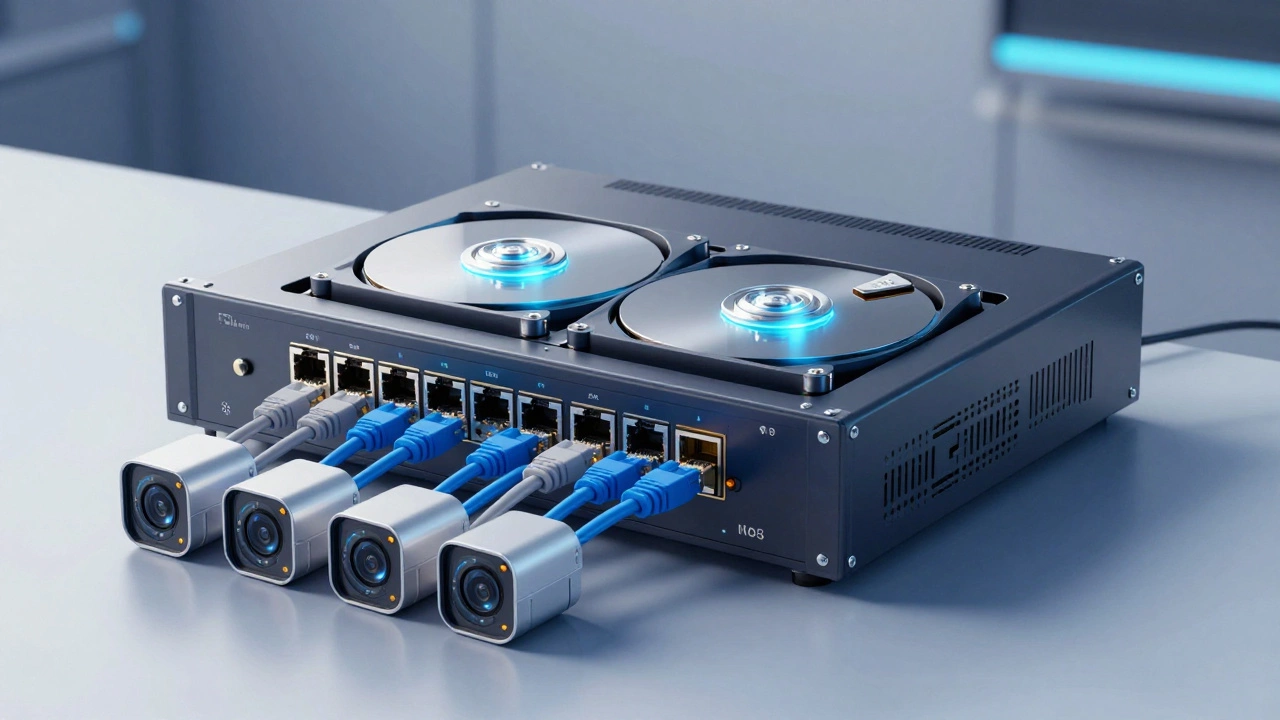
Modern systems often use IP Cameras are digital network cameras that transmit video data over an IP network connected to an Network Video Recorder (NVR) is a device that receives and records video streams from IP cameras. Unlike DVRs, NVRs use Ethernet cables (Cat5e or Cat6) to connect cameras.
Here is where it gets interesting. An NVR system creates a local network between the cameras and the recorder. This is called a LAN (Local Area Network). It does not require an internet connection (WAN) to function. As long as the cameras and the NVR are plugged into the same switch or hub, they communicate seamlessly. The video is stored locally on the NVR’s hard drive.
Many people confuse "Ethernet" with "Internet." They are not the same. Ethernet is just a way for devices to talk to each other. So, an NVR system works perfectly fine without Wi-Fi and without an active internet subscription. You just won’t be able to check the cameras from your smartphone while you’re at work.
| Feature | Analog (DVR) | IP (NVR) |
|---|---|---|
| Cable Type | Coaxial | Ethernet (Cat5/Cat6) |
| Resolution Quality | Standard (720p-1080p) | High (4K-8K available) |
| Installation Difficulty | Moderate (Heavy cables) | Moderate (Lighter cables) |
| Smart Features | Limited | Advanced (AI detection possible) |
| Offline Capability | Full | Full |
Standalone Cameras with Local Storage
If you don’t want to deal with recorders or complex wiring, you might consider standalone cameras with built-in storage. These are popular for small businesses, rentals, or temporary monitoring.
SD Card Recording
Many budget-friendly IP cameras and some older analog models support microSD cards. You insert a card into the camera, and it loops recordings directly onto the chip. This requires absolutely no external hardware. However, there are significant downsides.
First, retrieval is manual. To watch the footage, you have to physically remove the SD card and plug it into a computer. Second, SD cards wear out faster than hard drives due to constant writing cycles. Third, if a thief breaks in and steals the camera, they take the evidence with them. For serious security, this method is less secure than a centralized NVR/DVR setup.
Cellular CCTV: The Wireless Alternative
What if you can’t run wires and you don’t have Wi-Fi? Maybe you’re monitoring a remote construction site, a rural farm, or a storage yard in Adelaide where broadband doesn’t reach. In these cases, cellular CCTV is your best friend.
These cameras contain a SIM card slot and use 4G LTE or 5G networks to transmit data. Brands like Reolink Go is a battery-powered security camera with 4G LTE connectivity and Arlo Go is a wireless security camera that operates on cellular networks are industry leaders here.
They work without Wi-Fi because they bypass your home internet entirely. Instead, they send video clips to the cloud via mobile data. You get alerts on your phone just like any other smart camera. The catch? Cost. You need a monthly data plan for the SIM card. Continuous HD streaming consumes massive amounts of data, so most cellular cameras only record when motion is detected to save bandwidth.
- Data Usage: Expect to use 1GB to 5GB per month per camera for standard motion-triggered recording.
- Power: Many cellular cameras are battery or solar-powered, adding another layer of independence from mains electricity.
Power Considerations: What Happens When the Lights Go Out?
We’ve talked about Wi-Fi, but there’s another critical dependency: electricity. A CCTV camera cannot work without power, regardless of whether it has Wi-Fi or not.
In a standard wired setup, if the power grid fails, your cameras die. To mitigate this, professional installers often pair NVRs with Uninterruptible Power Supplies (UPS). A UPS is essentially a large battery that keeps your recorder and cameras running for a few hours during a blackout. This ensures you don’t miss the moment a burglar takes advantage of the darkness.
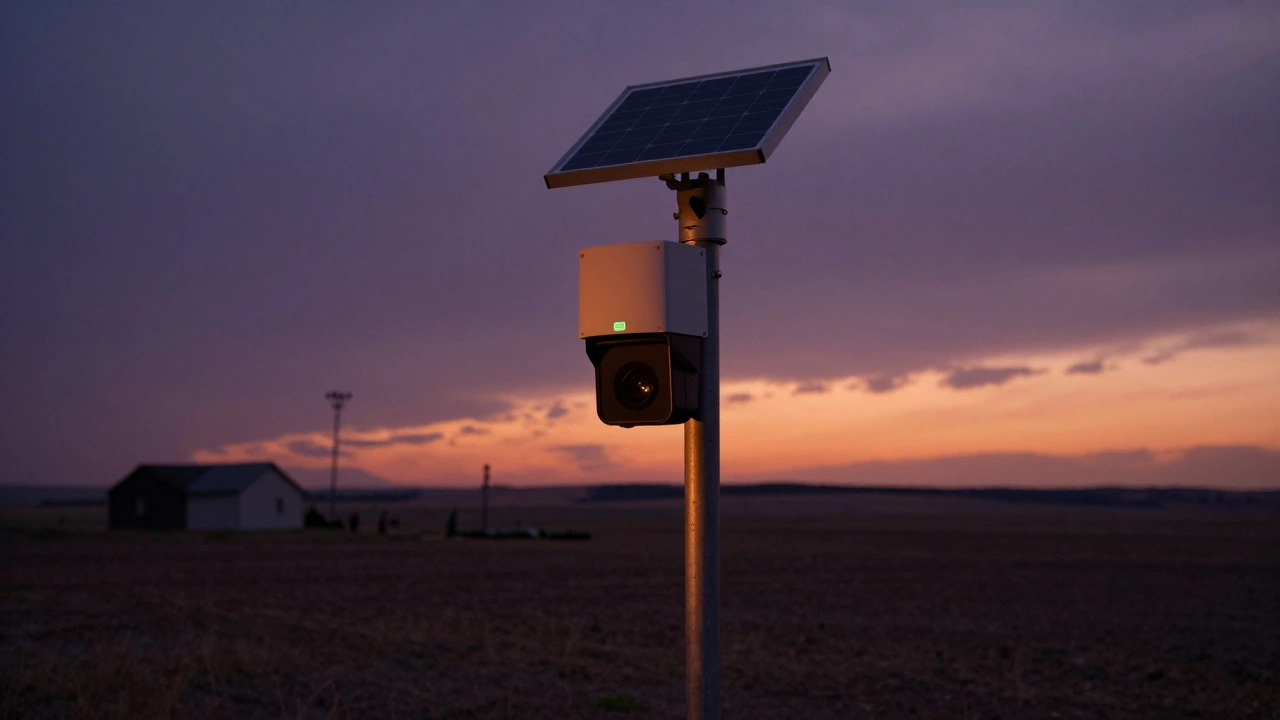
For truly off-grid solutions, solar-powered cameras are becoming increasingly viable. They charge during the day and store energy for night-time operation. Combined with cellular connectivity, these systems offer complete independence from both the electrical grid and the internet infrastructure.
Privacy and Security Benefits of Going Offline
One major reason people choose offline systems is privacy. Cloud-connected cameras send your video data to third-party servers. While reputable companies encrypt this data, it still leaves a potential attack surface. Hackers can exploit weak passwords or software vulnerabilities to access cloud accounts.
With a local DVR or NVR system, your footage never leaves your property. It stays on the hard drive inside your house or office. There is no cloud account to hack, no password to leak online. This "closed loop" architecture is why banks, government buildings, and high-security facilities prefer local storage. It gives you total control over who sees your data.
How to Choose the Right System for You
Deciding between Wi-Fi-dependent and offline-capable systems comes down to three factors: location, budget, and usage.
- Do you have reliable internet? If yes, and you want remote access, a hybrid system (NVR with optional internet) is best. If no, go wired or cellular.
- Is installation easy? If you can’t drill holes or run cables, look at battery/cellular options. If you’re building a new home or renovating, hardwiring is cheaper and more reliable in the long run.
- What is your budget? Wired systems have a higher upfront cost but zero monthly fees. Cellular systems have lower upfront costs but ongoing data charges.
Remember, "wireless" marketing often hides the truth. Always check if a camera requires a hub, a recorder, or a data plan. Don’t let the term "smart camera" trick you into thinking it works without infrastructure. True independence requires either physical cables or a cellular connection.
Will my Wi-Fi camera record if the internet goes down?
It depends on the camera. If it has local storage (SD card), it will likely continue recording. If it relies solely on cloud storage, it may stop recording or buffer footage until the connection returns, potentially losing data.
Can I add Wi-Fi to an existing wired CCTV system later?
Yes, most modern DVRs and NVRs have Ethernet ports. You can connect the recorder to your router via a cable to enable remote viewing apps without changing the cameras themselves.
Are cellular cameras more expensive than Wi-Fi cameras?
The hardware is often similarly priced, but cellular cameras incur ongoing monthly data costs. Over two years, a cellular system can cost significantly more due to subscription fees.
How much storage do I need for offline recording?
A typical 4-channel system recording 1080p video continuously needs about 1TB of storage for roughly two weeks of footage. Higher resolutions like 4K require larger drives, such as 4TB or 8TB.
Can I use old analog cameras with a new NVR?
Generally, no. Analog cameras require a DVR. IP cameras require an NVR. However, some hybrid recorders exist that can handle both types, allowing for gradual upgrades.