
Motion Light Rain Resistance Guide
Find your perfect rain-resistant motion light
Enter your situation to get personalized recommendations for motion lights that won't trigger in the rain
How often do you experience rain?
What's your budget?
What type of sensor do you have?
What's your main concern?
Yes, rain can trigger motion lights - and it’s more common than you think.
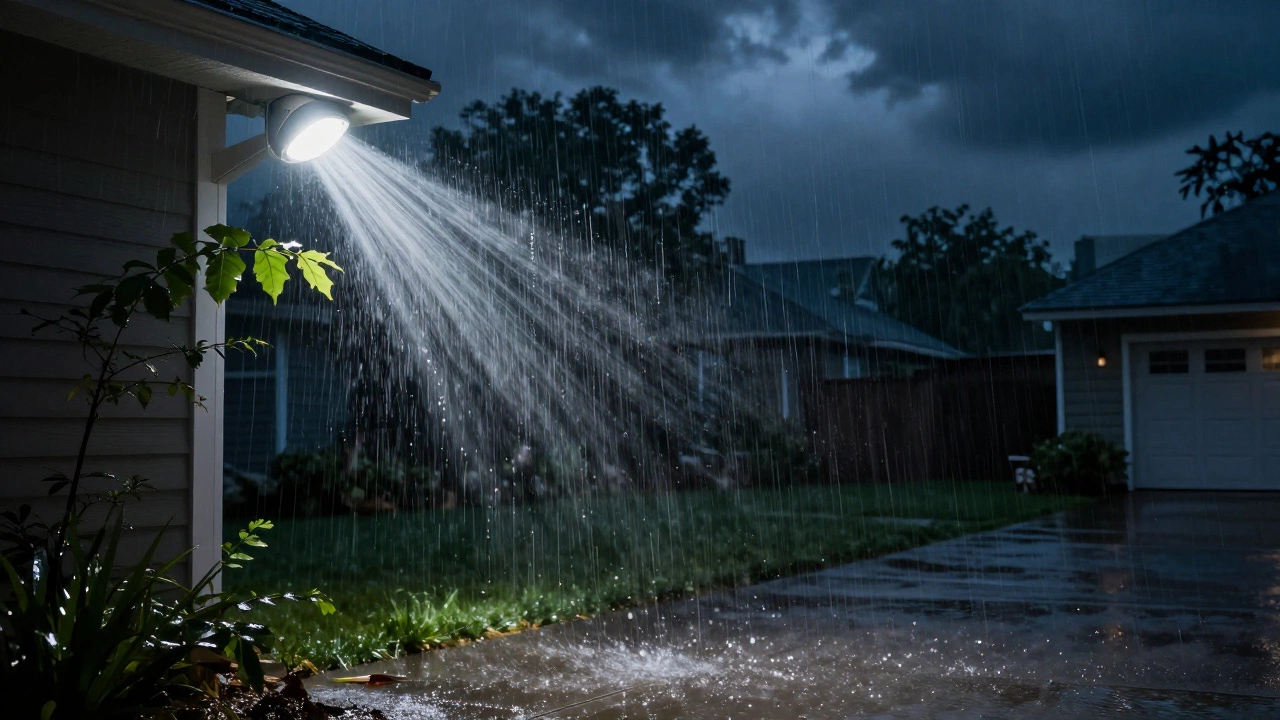
Picture this: it’s pouring outside, you’re curled up on the couch, and suddenly your backyard floodlight flashes on. Again. And again. Every couple of minutes. You check your phone - no one’s there. No animal. Just rain. If this sounds familiar, you’re not alone. Rain doesn’t just wet your driveway - it can trick your motion-activated lights into thinking someone’s walking past.
Why does rain set off motion sensors?
Motion lights don’t "see" like your eyes. Most use something called a PIR sensor - passive infrared. These sensors don’t detect shapes or movement the way a camera does. Instead, they watch for sudden changes in heat patterns. A person walking by gives off body heat, which stands out against cooler background surfaces. That’s what triggers the light.
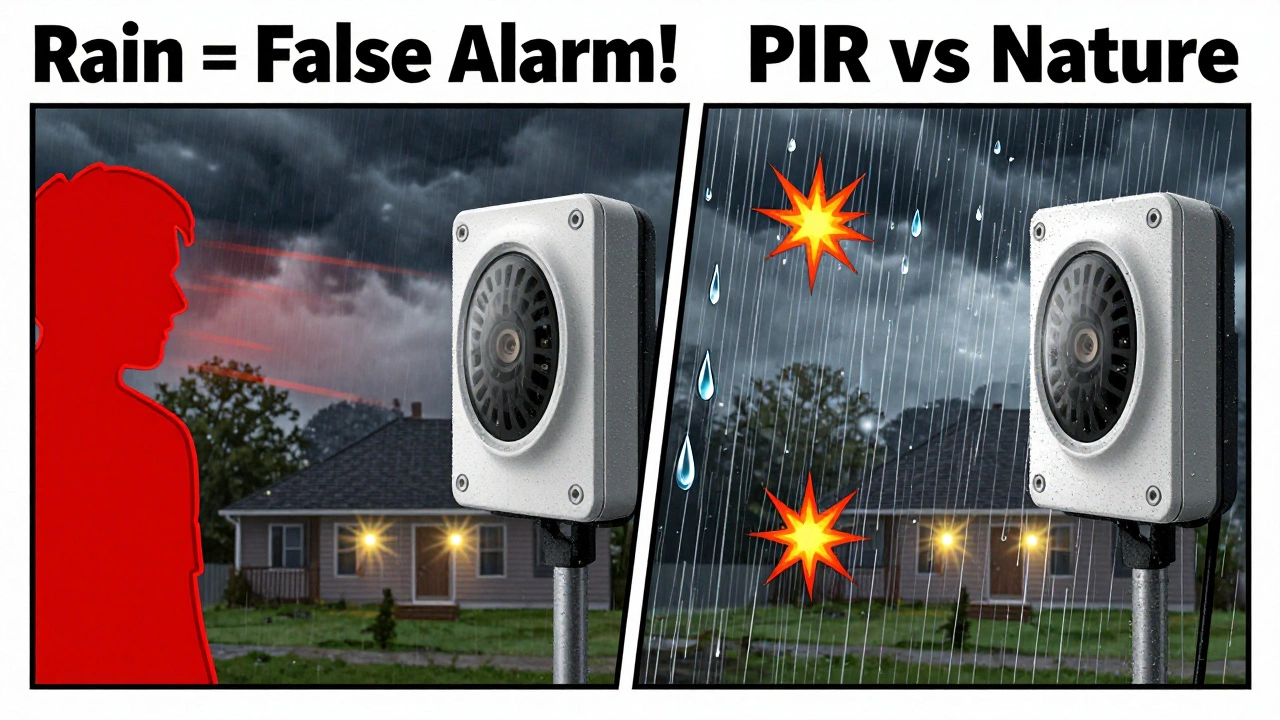
Rain messes with that system. Each raindrop falling through the air creates tiny, fast shifts in temperature. Water droplets are usually cooler than the air around them, especially when they’re falling from clouds. As they pass through the sensor’s field of view, they create brief, rapid heat spikes and drops. To the sensor, that looks like something moving - maybe a person, maybe an animal.
It’s not just the drops themselves. Rain hits leaves, gutters, fences, and the ground. That causes branches to sway, water to splash, and debris to shift. All of that movement adds to the noise. Even if the sensor is mounted high up, falling rain can still create enough thermal chaos to set it off.
Not all motion sensors are the same
There are three main types of motion sensors used in outdoor lights, and they react to rain very differently.
- PIR-only sensors (85% of the market): These are the cheapest and most common. They’re great for detecting people, but they’re also the most sensitive to rain. In tests, they triggered between 12 and 47 false alarms per hour during moderate rain.
- Radar-based sensors (10% of the market): These use radio waves to detect movement. They’re better than PIR at ignoring heat changes, but they can still pick up splashing water or wind-blown debris. They typically trigger 5 to 15 times per hour in rain.
- Dual-technology sensors (5% of the market): These combine PIR and radar. Both sensors have to agree that something’s moving before the light turns on. This cuts false triggers way down - to just 1 to 8 per hour in the same rain conditions.
If you’re buying a new light, go for dual-technology. It’s more expensive - often $30 to $50 more - but if you live somewhere with frequent rain, it’s worth it. You won’t be stuck with lights flashing every 90 seconds during a storm.
Real-world examples: What users are seeing
People are talking about this problem everywhere.
On Reddit’s r/HomeSecurity, one user reported their Ring Floodlight Cam (2022 model) triggered every 90 seconds during rain, even with sensitivity turned all the way down. Another user on the Arlo forums said their lights went off nonstop as soon as the rain started - and kept triggering right after each 120-second recording ended.
Amazon reviews for top-selling motion lights have over 1,800 mentions of "rain" - and 68% of those describe false triggers. The GE C-TECH Motion Sensor Light, a popular budget model, has a 3.7 out of 5 rating for weather performance. The most common complaint? "Goes off every 2 minutes when raining."
Manufacturers know this is a problem. Arlo’s newer Pro 5 series, released in late 2023, includes a feature called "RainMode" that uses machine learning to tell the difference between falling water and a person. They say it cuts false triggers by 82%. Ring’s newer Floodlight Cam Pro, released in 2024, connects to local weather data and automatically lowers sensitivity when rain is forecasted.
How to stop your lights from going off in the rain
You don’t have to buy a new light to fix this. Here are five practical fixes that actually work:
- Lower the sensitivity. Most sensors let you adjust this from 1 to 10. Set it to 2 or 3. You’ll miss a few distant movements, but you’ll stop most rain triggers.
- Reposition the light. Mount it under an overhang, porch, or eave. Even a small roof over the sensor can block direct rain. PAc Lighting’s research shows that angling the sensor 15-20 degrees downward reduces rain interference by 60%.
- Trim nearby bushes and trees. Rain hitting leaves causes them to shake. That movement gets picked up as motion. Keep vegetation at least 3 feet away from the sensor’s view.
- Add a simple rain shield. A small plastic or metal hood placed above the sensor - like a tiny awning - can deflect rain without blocking the field of view. Many users have shared 3D-printed designs online that cost less than $5 to make.
- Upgrade to a dual-sensor model. If you’re replacing the light anyway, skip the cheap PIR-only option. Spend the extra money on a dual-technology light. The difference in performance is dramatic.
What to look for when buying new outdoor lights
Not all "weatherproof" lights are created equal. Look for these specs:
- IP67 or IP68 rating: This means the light is sealed against water jets and temporary submersion. Avoid IP65 - it’s only splash-resistant.
- Dual-technology detection: PIR + microwave or radar. This is the gold standard for reducing false alarms.
- AI weather filtering: Newer models use software to ignore rain patterns. Check the product description for phrases like "rain immunity," "weather intelligence," or "adaptive sensing."
- Adjustable range and angle: You want to be able to narrow the detection zone so it only watches your walkway, not the whole yard.
As of 2025, 67% of new motion lights on the market advertise rain resistance as a key feature. That’s up from just 29% in 2021. Consumers are demanding better performance - and manufacturers are listening.
The future: AI is making motion lights smarter
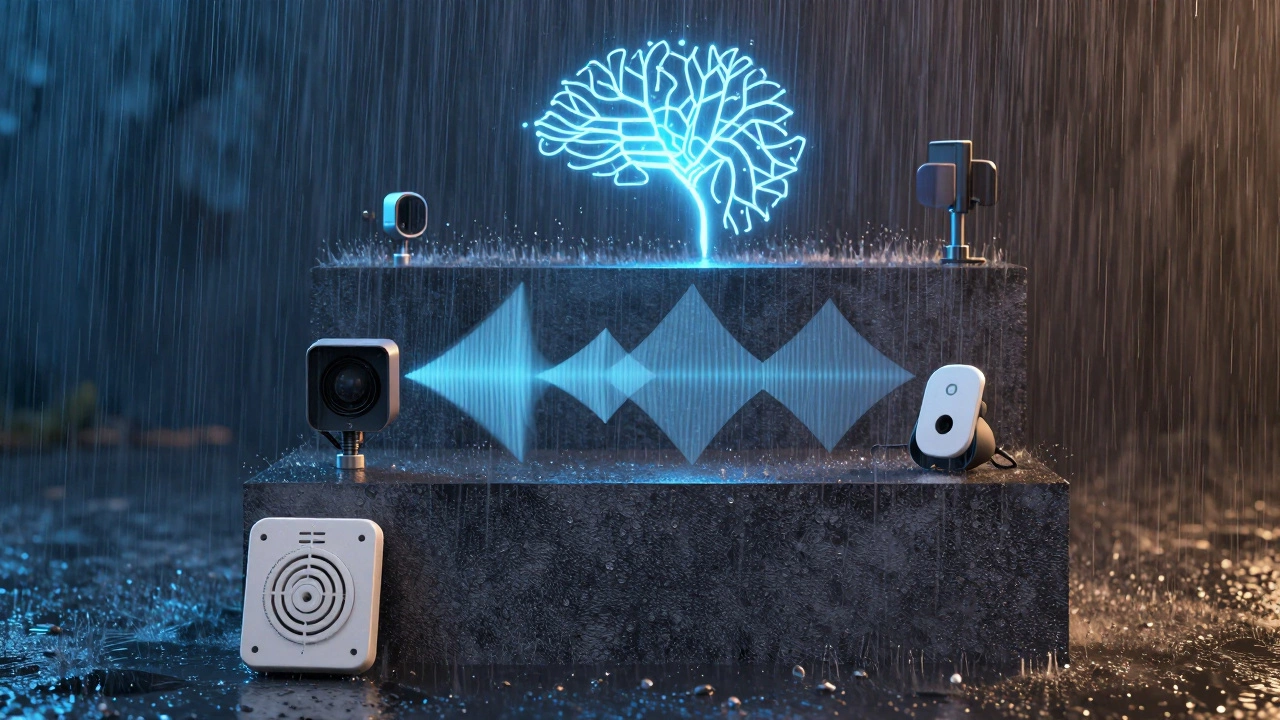
The next big leap isn’t in hardware - it’s in software. Companies are training sensors to recognize the difference between rain, wind, animals, and people using machine learning. The Lighting Research Center at Rensselaer Polytechnic Institute tested a prototype sensor that combines infrared, visible light, and motion data. In lab conditions, it reduced rain false triggers by 94%.
ABI Research predicts that by 2027, nearly 8 out of 10 premium motion lights will have AI-based weather filtering. That means your light won’t just react to movement - it’ll understand what kind of movement it’s seeing.
Right now, these smart lights cost 40-60% more than basic models. But prices are dropping. In five years, AI filtering will be standard - not a luxury.
Bottom line: Rain triggers motion lights - but you can fix it
Yes, rain can set off your motion lights. It’s not a defect. It’s how the sensors work. But you don’t have to live with it.
If you’ve got an older model, try adjusting the sensitivity, repositioning the light, or adding a shield. If you’re buying new, skip the cheapest option. Go for dual-technology with an IP67 rating. You’ll sleep better knowing your lights only turn on when they should.
The technology is getting better. Soon, your motion lights won’t just be smart - they’ll be weather-smart too.
Can rain really set off motion lights, or is my sensor broken?
Yes, rain can absolutely trigger motion lights - and it’s not a sign your sensor is broken. Most outdoor motion lights use PIR sensors that detect heat changes, not visual movement. Falling raindrops create rapid temperature shifts that mimic the heat signature of a person or animal. This is a known issue across all major brands, including Ring, Arlo, and GE. It’s a limitation of the sensor technology, not a defect.
Do all motion lights trigger in the rain?
No. Only PIR-only sensors are highly prone to rain triggers. About 85% of outdoor motion lights use this type. Radar-only sensors are less affected, and dual-technology sensors (PIR + radar or microwave) are the most resistant. These combine two detection methods and only activate when both sensors agree - which cuts rain false triggers by up to 90%. If your light goes off constantly in rain, it’s likely a basic PIR model.
Can I fix rain triggers without buying a new light?
Yes. First, lower the sensitivity setting to the lowest level that still catches real movement. Second, reposition the light under an overhang or angle it slightly downward - this can reduce false triggers by 60%. Third, trim bushes or trees near the sensor so rain doesn’t make them sway. You can also add a simple plastic or metal shield above the sensor to deflect rain. Many users have built DIY shields for under $10.
What should I look for in a rain-resistant motion light?
Look for three things: 1) Dual-technology detection (PIR + radar or microwave), 2) IP67 or IP68 weather rating (not just IP65), and 3) AI or weather filtering features. Brands like Arlo Pro 5 and Ring Floodlight Cam Pro now include software that ignores rain patterns. These lights cost more - $100-$130 - but they eliminate the constant false alarms that plague cheaper models.
Are motion lights with AI filtering worth the extra cost?
If you live in a rainy climate, yes. AI filtering uses machine learning to distinguish between rain, wind, animals, and people. Arlo’s RainMode and Ring’s Precipitation Intelligence reduce false triggers by 80% or more. The extra $30-$50 you pay upfront saves you from endless alerts, drained batteries, and wasted recording time. In the long run, it’s cheaper than replacing batteries or dealing with false alarms every time it rains.