
Security Light Cost Calculator
Security Lighting Comparison
Calculate your energy costs and savings when switching from continuous lighting to motion-activated LED lights.
Results
Continuous Lighting
Energy Use: kWh/month
Cost: /month
Motion-Activated LED
Energy Use: kWh/month
Cost: /month
Leaving a security light on all night might feel like the safest choice-after all, darkness hides trouble, right? But here’s the truth: keeping a traditional security light blazing through the night isn’t just wasteful, it might actually make your home less secure. The real question isn’t whether you can leave it on-it’s whether you should.
Why Continuous Lighting Isn’t the Best Strategy
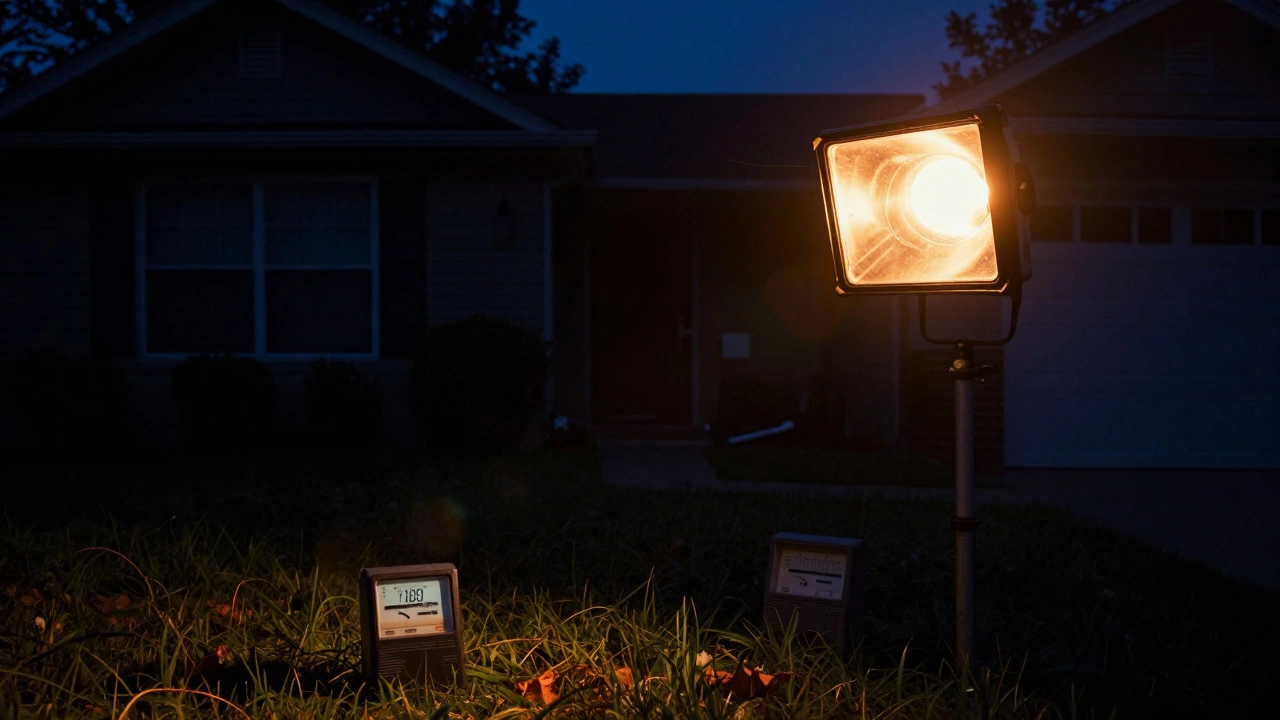
For decades, homeowners assumed that bright, all-night lighting kept burglars away. But modern security experts say otherwise. Constant light creates predictable patterns. Intruders learn when and where the light stays on. They wait for the dark gaps between fixtures. They use shadows to move unseen. A 100-watt halogen floodlight left on for 12 hours uses 1.2 kilowatt-hours per night. That’s over 36 kilowatt-hours a month-enough to power a small refrigerator. At $0.12 per kWh, that’s $4.32 a month, just for one light. Two lights? Nearly $9. Add a third, and you’re paying more than your phone bill just to shine light into the yard.And it’s not just money. Incandescent or halogen bulbs last about 1,000 to 2,000 hours. If you leave one on 12 hours a day, it dies in 83 to 166 days. That’s replacing bulbs every three to five months. You’re spending time, money, and effort just to keep a light glowing-while getting diminishing returns on security.
The Power of Motion-Activated Lighting
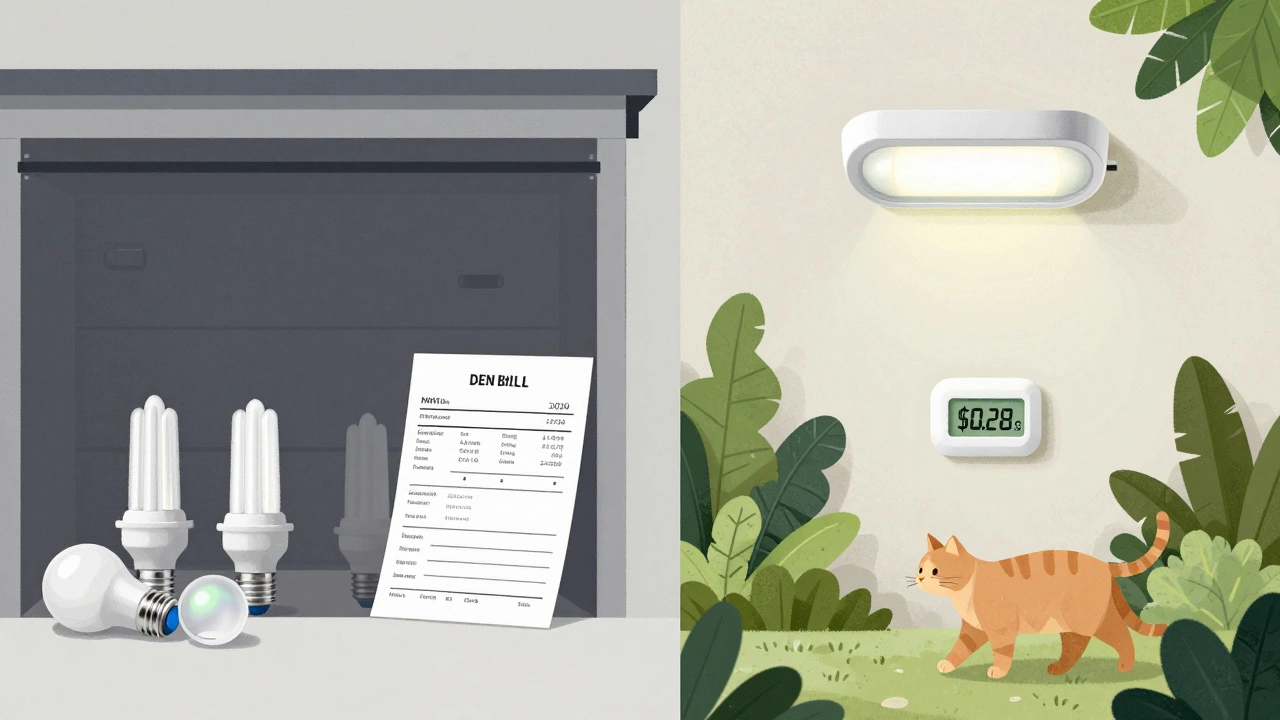
Switching to motion-activated LED security lights changes everything. These lights stay off until movement is detected-then they blast on with bright, focused light for 30 seconds to 5 minutes. That’s it. No more wasting energy while you sleep, watch TV, or go on vacation.Here’s the math: a 15-watt LED motion light that activates twice a night for 90 seconds each time uses just 0.075 kilowatt-hours daily. That’s less than 2.3 kilowatt-hours a month. At $0.12 per kWh, that’s 28 cents a month. Compare that to the $4.32 for a continuous halogen light. You’re saving over 90% on energy.
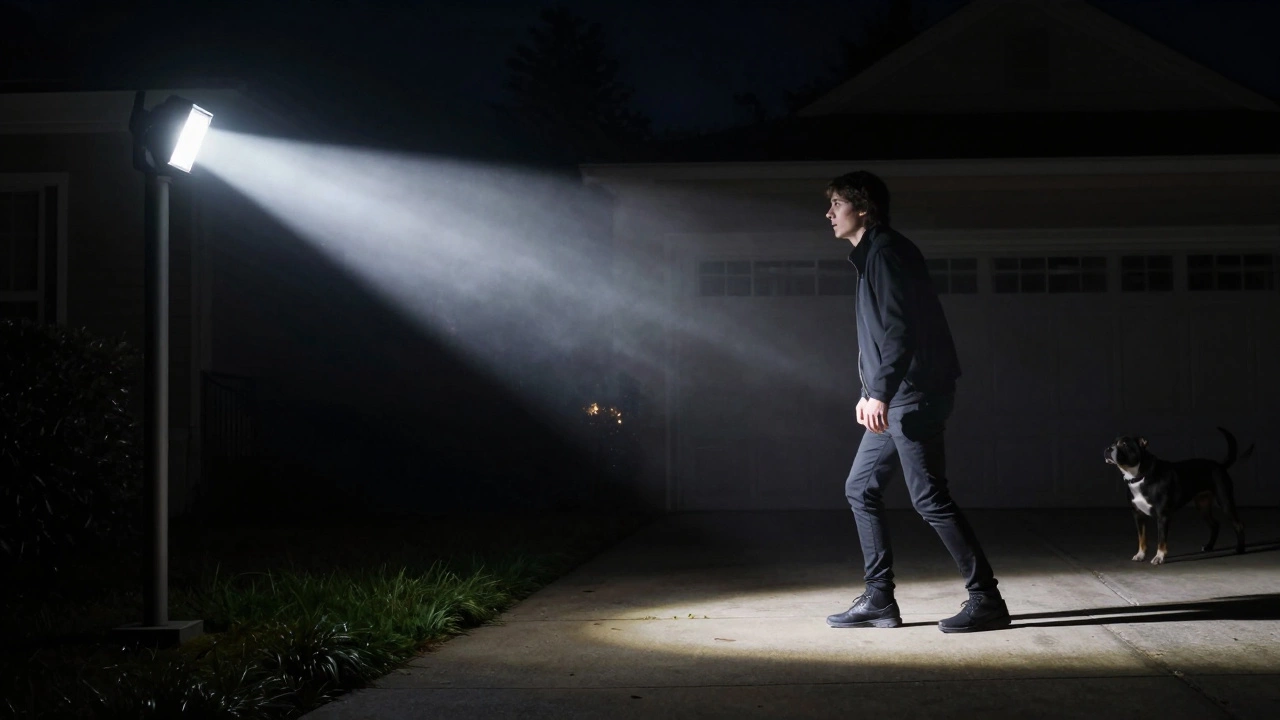
But the real win? Security. Sudden illumination startles intruders. It doesn’t just light up the driveway-it shocks them. That split-second of blinding light gives them a reason to freeze, get caught on camera, or run. Security firms like Millennium Security Services say this sudden glare is one of the most effective deterrents because it draws attention. Neighbors hear the click. Dogs bark. Lights turn on across the street. Burglars don’t want witnesses. They want silence and shadows. Motion lights take both away.
LEDs Are the Only Smart Choice
Not all motion lights are created equal. The bulb type matters more than you think. LED technology uses at least 75% less energy than old incandescent bulbs and lasts 25 times longer. A typical LED security light lasts 50,000 hours. That’s over 11 years if it runs 12 hours a day-or 20+ years with motion activation. You’ll likely outlive the fixture before you need a replacement.Modern LED security lights also come with smart features: adjustable sensitivity, dusk-to-dawn sensors, and even Wi-Fi connectivity. You can set how far the motion sensor reaches-so your cat doesn’t trigger it, but a person walking up the steps does. Some models dim to low light when no motion is detected, then brighten instantly when someone approaches. Others sync with your smart home system, sending alerts to your phone when they turn on.
What About Battery and Solar Lights?
Battery-powered and solar lights are great for areas without wiring. But they come with trade-offs. Battery lights often dim over time, especially in cold weather. Most last about a year before needing replacement. Solar lights depend on sunlight-so if your yard is shaded or it rains for weeks, the battery drains. Still, they’re a solid option for side yards, garden paths, or remote entry points.Hardwired LED motion lights are the gold standard. They get steady power, stay bright, and don’t need battery swaps. If you’re installing new lights, go hardwired. If you’re stuck with battery or solar, choose models with replaceable batteries and high-capacity lithium cells. Look for IP65 or higher weather ratings-these handle rain, snow, and dust without failing.
When Continuous Lighting Still Makes Sense
There are exceptions. Commercial properties, warehouses, or homes in high-crime areas with frequent break-ins may benefit from continuous lighting. So might homes with elderly residents who need constant visibility at night to avoid falls. If you have a driveway that sees heavy nighttime traffic, or a gate that needs to be monitored 24/7, continuous lighting can help. But even then, use LED. Never use old halogen or incandescent bulbs.Another smart option: hybrid systems. Install motion lights for the front yard and driveway, but leave a single low-watt LED fixture on near the back door or garage-just enough to prevent tripping, not enough to waste power. It’s the best of both worlds.
Real-World Results
Homeowners who switched from continuous halogen to motion-activated LED lights report the same pattern: lower bills, fewer bulb changes, and a stronger sense of safety. One user on Reddit shared that two 100-watt floodlights added $15 to their monthly bill. After switching to LED motion lights, their bill dropped by $12.50. They also noticed burglars avoided their street after neighbors installed similar systems.Another homeowner in Minnesota replaced six old fixtures with motion-activated LEDs. Within three months, she got a call from a neighbor who saw someone casing the house. The lights flashed on as the person walked past the driveway. The neighbor called police. The suspect was caught. The lights didn’t just deter-they helped catch a criminal.
What to Do Next
If you’re still using old-style security lights that stay on all night, here’s what to do:- Check your bulbs. If they’re incandescent or halogen, replace them with LED.
- Upgrade to motion sensors. Buy lights with adjustable sensitivity and timers. Don’t settle for basic models.
- Install them right. Mount lights 8-10 feet high, angled down toward walkways and entry points. Avoid shining directly into neighbors’ windows.
- Clean the sensors. Dust, spider webs, and snow can block motion detectors. Wipe them every few months.
- Test them. Walk in front of the light after dark. Does it turn on fast? Does it stay on long enough?
You don’t need to light up your whole yard to keep it safe. You just need to light up the right moments.
Common Myths About Security Lights
- Myth: Brighter is always better. Truth: Overly bright lights create glare and blind cameras. They also annoy neighbors. Aim for focused, not blinding.
- Myth: Motion lights let intruders in. Truth: They only activate when someone’s there. That’s the point.
- Myth: Solar lights are too weak. Truth: Modern solar LEDs are bright enough for security if placed in direct sunlight.
- Myth: Leaving lights on deters crime. Truth: Predictable light = easy targets. Surprise light = real deterrent.
Is it safe to leave a security light on all night?
It’s physically safe, but not smart. Constant lighting wastes energy, shortens bulb life, and gives intruders a predictable pattern to work around. Motion-activated lights are more effective and cost-efficient.
How much does it cost to leave a security light on all night?
A 100-watt halogen light left on 12 hours a day costs about $0.29 per day, or $8.70 per month. A 15-watt LED motion light, activated just 2 hours a night, costs under $0.03 per day-over 90% less.
Do motion sensor lights use a lot of electricity?
No. LED motion lights use very little power because they’re off most of the time. A typical unit uses less than 0.1 kWh per day, even with multiple activations. That’s less than a phone charger.
How long do LED security lights last?
Most LED security lights last 50,000 hours. If used 12 hours a day, that’s over 11 years. With motion activation, they can last 15-20 years. That’s longer than most home warranties.
Are battery-powered security lights reliable?
They’re fine for low-traffic areas like side yards or garden paths, but not ideal for main entry points. Batteries drain faster in cold weather and need replacing yearly. Solar models last longer but need direct sun. Hardwired LED lights are more reliable overall.
What’s the best placement for outdoor security lights?
Mount lights 8-10 feet high, angled down toward doors, driveways, and walkways. Avoid pointing them at windows or roads. Use multiple lights to cover blind spots. Motion sensors should face the most likely approach paths-like the front porch or garage entrance.
Can motion lights be tricked by intruders?
It’s possible, but unlikely with modern systems. Newer sensors use advanced algorithms to ignore pets, swaying branches, or passing cars. Many let you adjust sensitivity and detection range. Place them so they cover the most vulnerable areas, not just the easiest paths.