
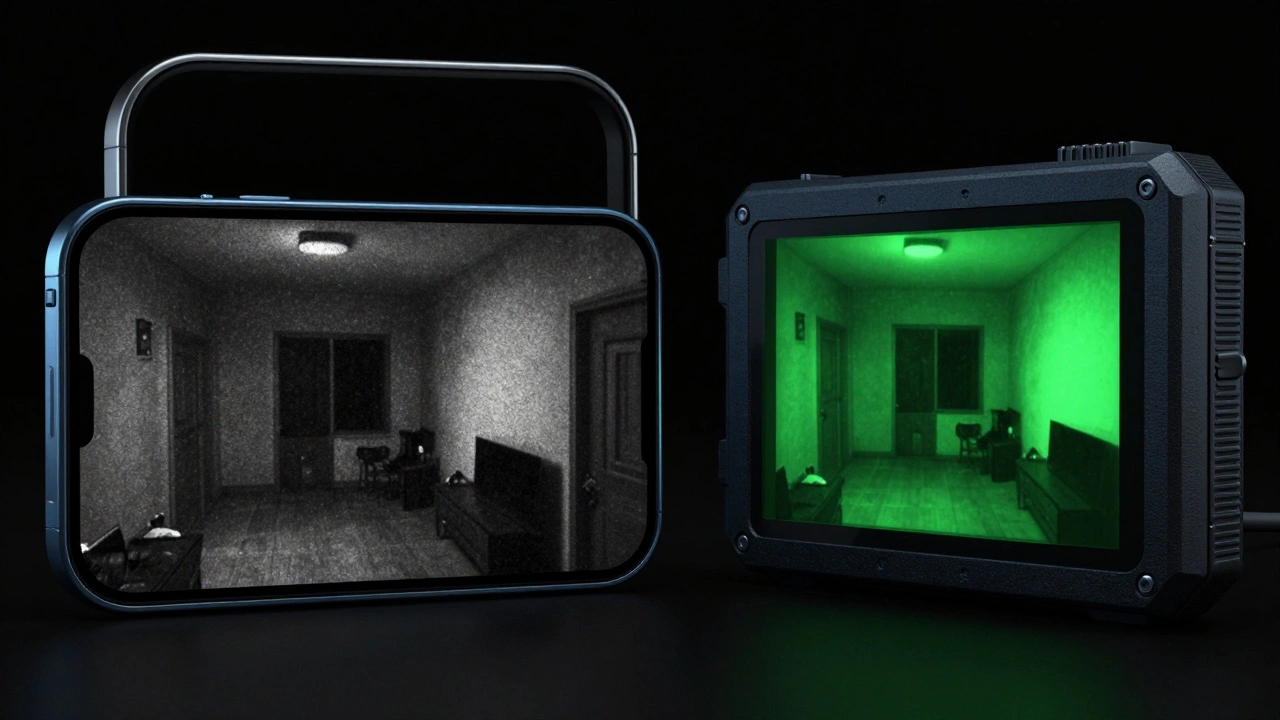
Night Vision Capability Finder
Standard Flagship Phone
AI ProcessingWhy this works for you:
If you are taking photos in dimly lit bars or at dusk, a standard modern phone is sufficient. You don't need true night vision; you need Low Light Enhancement. Modern sensors combined with AI software can stack frames to brighten images without extra hardware.
Recommended Tech Specs:
- ✔ Large Aperture Lens (f/1.8 or lower)
- ✔ OIS (Optical Image Stabilization)
- ✔ Latest Snapdragon or Apple A-series Chip
Can your phone see in the dark like a predator cat or a military-grade device? If you’ve ever tried to take a photo in a pitch-black room with your standard smartphone, you know the answer is usually a grainy mess. But technology has moved fast. Today, "night vision" on a phone isn't just a marketing buzzword; it’s a real capability, though it works very differently than you might think.
The short answer is: No, most standard smartphones do not have true infrared (IR) night vision out of the box. However, they are getting dangerously close using artificial intelligence, and there is a growing market of rugged phones that actually include dedicated night-vision hardware. Let’s break down what your phone can really do in the dark, how the tech works, and whether you need to buy a special device to see in total darkness.
Why Your Standard Phone Can’t See in Total Darkness
To understand why your iPhone or Samsung Galaxy struggles when the lights go out, we have to look at the camera sensor. Inside every smartphone is a silicon image sensor (CMOS). Interestingly, these sensors are naturally sensitive to near-infrared (NIR) light-the same invisible light used by TV remotes and security cameras.
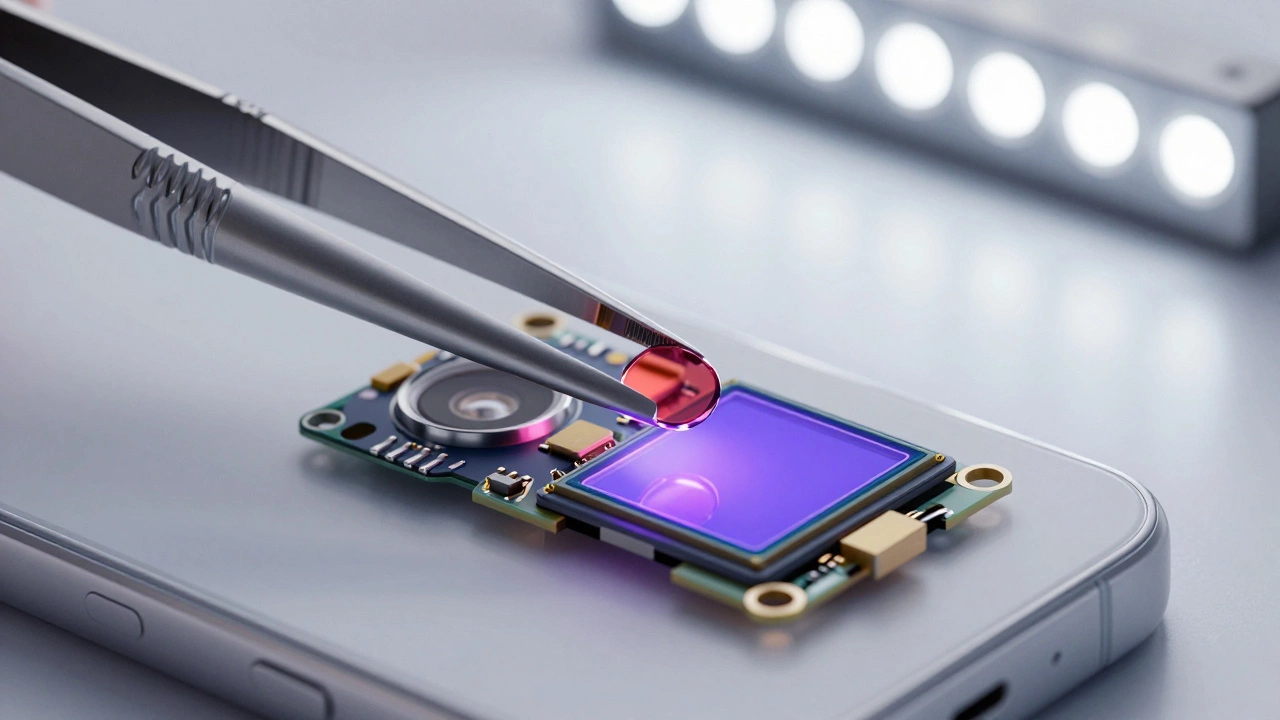
So why don’t they work as night-vision devices? Because manufacturers deliberately block that light. Every consumer smartphone lens has an infrared cut filter a small reddish glass element placed over the sensor to block IR wavelengths. This filter ensures your photos look natural in daylight. Without it, everything would have a strange pink or purple tint because the sensor would pick up IR reflections from surfaces.
This means that in total darkness-where there is zero visible light and no external IR source-your standard phone sees nothing. It cannot amplify non-existent light. It relies entirely on whatever tiny amount of ambient light is left (moonlight, streetlights) and tries to stretch it using software tricks like increasing ISO or stacking multiple frames. This works for dim rooms, but it fails in a blackout.
The Rise of Software Night Vision: AI to the Rescue
If you can’t change the hardware, you change the math. In mid-2024, a major shift happened with the introduction of Night Vision for Mobile a software solution developed by Qualcomm and Visionary.ai that uses AI to enhance low-light video. This technology doesn’t use infrared LEDs. Instead, it uses aggressive AI denoising on the standard camera sensor.
Here is how it works:
- Capture: The phone’s sensor grabs extremely noisy, dark footage.
- Processing: The Qualcomm Spectra Image Signal Processor (ISP) sends this data to Visionary.ai’s algorithm.
- Reconstruction: The AI predicts what the scene should look like based on patterns it has learned, effectively cleaning up the noise and brightening the image in real-time.
The result is full-color video that looks usable even when the human eye sees almost nothing. This is huge for vloggers, journalists, or anyone filming at night. However, keep in mind: this is still limited by the physical limits of the sensor. It needs some photons hitting the lens. It cannot create light where there is none. It is "low-light enhancement," not true "zero-light" night vision.
Hardware Night Vision: Rugged Phones with IR Cameras
If you need to see in a cave, a locked basement, or deep wilderness with absolutely no light, software won’t cut it. You need hardware. This is where rugged phone brands like Oukitel, Ulefone, and Doogee come in. These aren’t your average pocket devices; they are built like tanks and often include dedicated infrared camera modules specialized sensors paired with IR LEDs that illuminate scenes invisible to the human eye.
| Model | Night Vision Type | Key Specs | Best For |
|---|---|---|---|
| Ulefone Armor 34 | Dedicated 64 MP IR Camera | 25,500 mAh Battery, 66W Charging | Long-duration outdoor security & camping |
| Doogee V20 Pro | 24 MP IR + Thermal Imaging | Thermal range up to 1,000m, 6,000 mAh | Industrial inspection, search & rescue |
| Oukitel Rugged Series | Built-in IR Illumination | Military-grade drop/water resistance | Construction sites, wildlife observation |
These phones typically feature two things standard phones lack:
- IR LEDs: Small lights around the camera that emit near-infrared light. You can’t see them, but the camera can. They act like flashlights for the IR sensor.
- IR-Sensitive Sensors: Unlike your main color camera, these secondary lenses often lack the IR-cut filter, allowing them to capture the reflected IR light clearly.
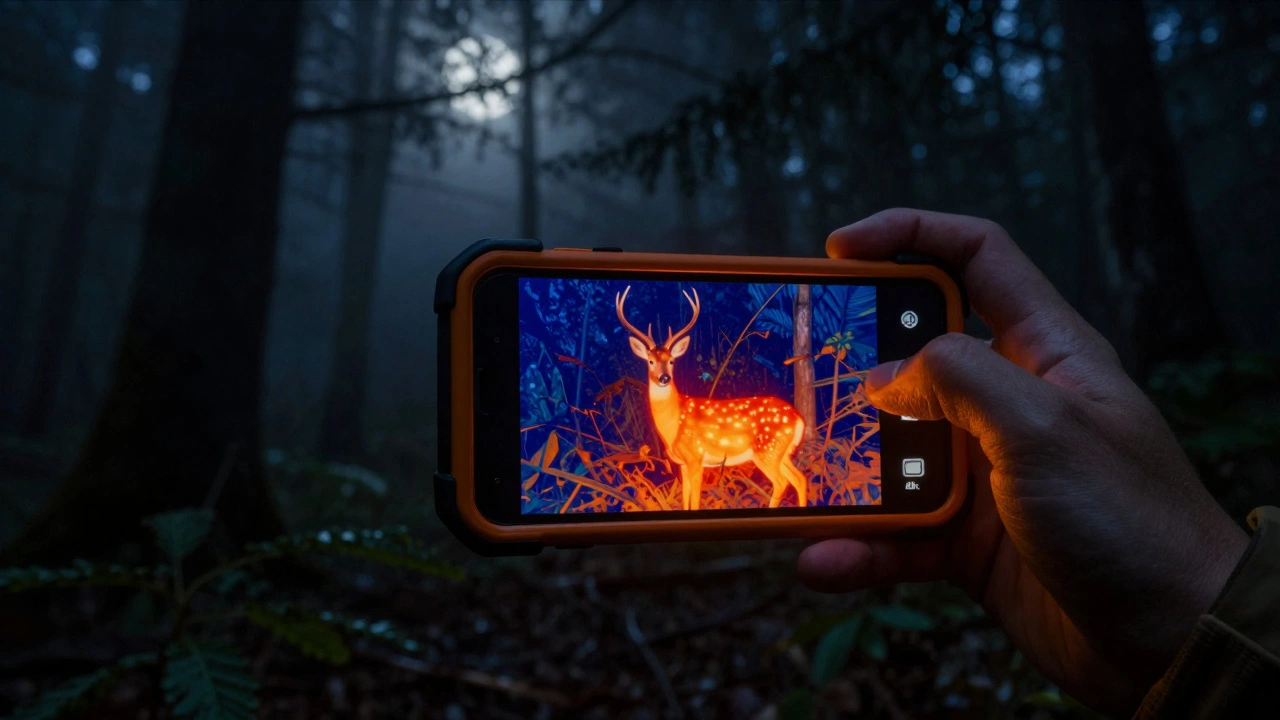
The output is usually monochrome (black and white) or green-tinted, similar to classic spy movies. The Doogee V20 Pro takes it further by adding thermal imaging, which detects heat signatures rather than reflected light, allowing users to spot animals or people through smoke or foliage from hundreds of meters away.
Can You DIY Night Vision on Your Current Phone?
If you’re handy with tools, you can technically turn any old smartphone into a night-vision camera. The process involves opening the phone, removing the camera module, and carefully prying off the reddish IR cut filter from the lens assembly.
Once that filter is gone, the sensor becomes sensitive to IR. Then, you point an external IR flashlight (or a cluster of 10-20 IR LEDs) at your subject. The phone will now display the IR reflection on its screen. Many people use this hack to create cheap IP security cameras by placing the modified phone in a shoebox with IR LEDs and running an app like Alfred.
Warning: This is risky. Modern phones are glued shut. Opening them often destroys the waterproofing, breaks delicate ribbon cables, or cracks the screen. Plus, once you remove the filter, your daytime photos will look washed out and weirdly colored. Only attempt this if you already own a broken phone you don’t care about.
Common Myths: What Night Vision Phones CANNOT Do
There is a lot of misinformation online about night vision capabilities. Let’s clear up two major myths right now.
Myth 1: Night vision can see through walls.
False. Night vision cameras, whether IR or thermal, rely on line-of-sight. Walls made of concrete, brick, or wood block both visible light and infrared radiation completely. No consumer phone can see through a wall. If you want to see inside a room, you need a camera inside that room.
Myth 2: All "Night Mode" photos are night vision.
False. When you tap "Night Mode" on your iPhone or Pixel, you are using computational photography, not night vision. The phone takes multiple long-exposure shots and stacks them to reduce noise. It still requires some ambient light. If you cover the lens completely, Night Mode produces blackness. True night vision produces an image using IR illumination in total darkness.
Which Option Is Right for You?
Your choice depends entirely on your use case.
If you are a content creator who films occasionally at dusk or in poorly lit bars, you don’t need a new phone. Stick with a flagship model equipped with the latest AI processing (like Qualcomm’s Night Vision for Mobile). It will give you clean, colorful video without extra hardware.
If you are a security professional, hunter, or outdoor enthusiast who operates in complete darkness, consider a rugged phone like the Ulefone Armor or Doogee V20 Pro. The added bulk and cost are worth it for the ability to see clearly when there is zero light. Just remember that these are niche devices; their primary cameras may not match the quality of a mainstream flagship.
If you are a DIY hobbyist looking for a budget security setup, salvaging an old phone and modifying the IR filter is a fun project, but be prepared for potential failure. Alternatively, buying a dedicated external NIR camera accessory (like those from RGMVision) offers a safer, more flexible route for specialized tasks like biometric testing.
Does my iPhone or Samsung have night vision?
Not in the traditional sense. They have excellent low-light performance thanks to large sensors and AI software (like Night Mode), but they cannot see in total darkness without some ambient light. They lack the infrared LEDs and IR-sensitive sensors found in dedicated night-vision devices.
What is the best phone for night vision in 2026?
For true hardware night vision, the Doogee V20 Pro and Ulefone Armor 34 are top contenders due to their dedicated IR cameras and rugged builds. For general low-light video quality on a standard phone, look for devices powered by the latest Snapdragon chips with Qualcomm's Night Vision for Mobile software integration.
Can I see through walls with a night vision camera?
No. Night vision technology relies on capturing reflected light (visible or infrared). Solid materials like walls, floors, and roofs block this light completely. There is no consumer technology that allows you to see through solid structures.
Is it safe to modify my phone to see infrared light?
It carries significant risks. Removing the IR filter voids your warranty, likely destroys water resistance, and can permanently damage the camera module if done incorrectly. It is recommended only for old, broken devices used for experimental projects.
What is the difference between thermal imaging and night vision?
Standard night vision (IR) reflects invisible light off objects, similar to how normal cameras reflect visible light. It needs an IR source (like an LED) to work in total darkness. Thermal imaging detects heat signatures emitted by objects themselves. Thermal cameras can see living beings through smoke, fog, or light foliage, regardless of lighting conditions.