
Baby Monitor Radiation Exposure Calculator
This calculator estimates your baby's RF radiation exposure based on monitor type and distance. The article explains that infants absorb up to 60% more radiation than adults due to their developing bodies.
Parents often worry about whether the baby monitor they rely on every night could be quietly harming their child. The short answer: radiation from baby monitors is not proven to cause harm, but that doesn’t mean it’s risk-free - especially for infants. Most wireless monitors use radiofrequency (RF) radiation, the same type emitted by Wi-Fi routers, cordless phones, and Bluetooth devices. They operate at around 2.4 GHz, which is non-ionizing radiation, meaning it doesn’t have enough energy to break DNA like X-rays or UV light do. But biology isn’t just about DNA damage. It’s about how developing bodies respond to constant, low-level exposure - and that’s where things get complicated.
How much radiation are babies really getting?
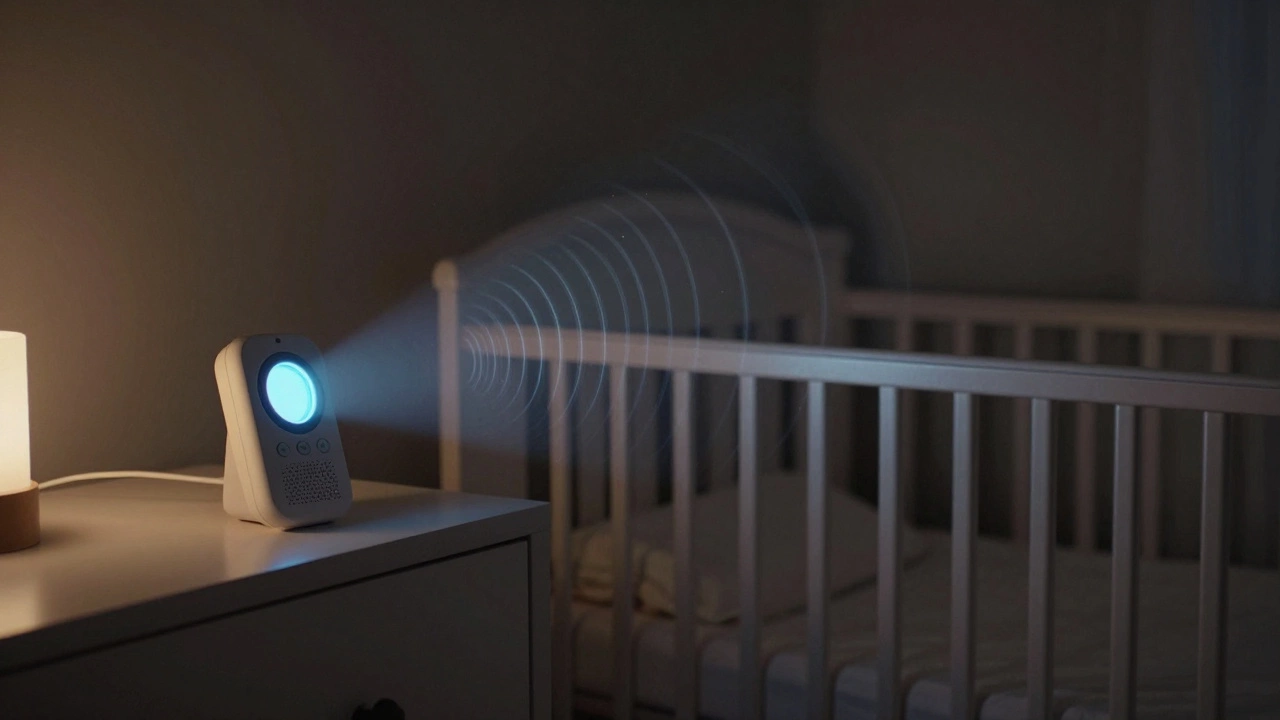
A baby monitor’s base station sits near the crib, often within 30 to 60 centimeters of the child’s head. It transmits continuously, even when there’s no sound. That means your baby is exposed to RF radiation 24 hours a day, seven days a week. The device might seem harmless - it’s just a small box with a light - but it’s essentially a tiny radio tower pointed directly at your infant.
The U.S. Federal Communications Commission (FCC) and the International Commission on Non-Ionizing Radiation Protection (ICNIRP) say these devices stay well below safety limits. Those limits were set based on studies of adult men, not newborns. That’s a problem. Infants have thinner skulls, higher water content in their tissues, and blood-brain barriers that aren’t fully formed. Their brains are growing at a rate faster than at any other time in life. A 2024 study from the National Institutes of Health found that infants absorb up to 60% more RF radiation than adults when exposed to the same source. Why? Because their bodies are smaller, their tissues are more conductive, and their cells are dividing rapidly - making them more vulnerable to environmental interference.
What does the science actually say?
There’s no smoking gun. No study has proven that baby monitors cause autism, cancer, or developmental delays. The American Academy of Pediatrics states there’s no known health risk under normal use. But that’s not the same as saying it’s safe. Science doesn’t prove safety - it looks for harm. And when you haven’t looked hard enough, absence of evidence isn’t evidence of absence.
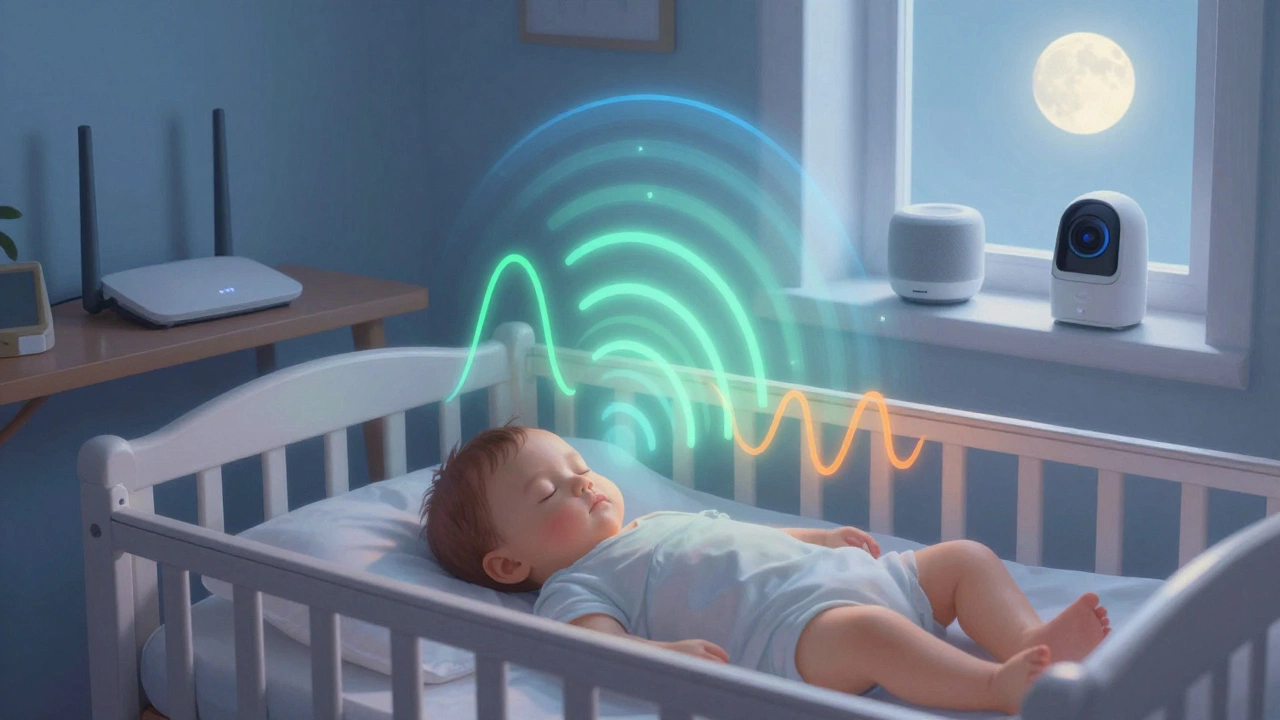
A 2025 pilot study published in Frontiers in Public Health looked at adults sleeping near a 2.45 GHz RF source - the same frequency used by most baby monitors. The results were startling. About 25% of participants showed clear signs of disrupted sleep, with measurable changes in brainwave patterns during deep sleep. Their EEGs showed spikes in gamma and beta waves - the same patterns linked to stress and alertness - even though the subjects didn’t wake up. They felt tired the next day. They didn’t know why. The researchers concluded: "Exposure to a 2.45 GHz radiofrequency device may impact sleep in some people under real-world conditions."
Now imagine that happening to a 3-month-old. Babies need 14 to 17 hours of sleep a day. Their brains use that time to prune unnecessary neural connections, strengthen memory pathways, and regulate hormones like melatonin. If RF radiation is subtly interfering with deep sleep cycles - even if they don’t cry or stir - could it affect their long-term development? Animal studies suggest yes. Rats exposed to similar RF levels in utero showed fewer neurons in brain regions tied to memory. Mice exposed after birth became hyperactive and struggled with learning tasks. These aren’t lab oddities - they’re signals that biology responds to this kind of exposure.
What about autism and brain development?
Some parents worry that baby monitors contribute to autism. That fear is understandable, but unfounded. Multiple large-scale studies have found no link between RF exposure from household devices and autism spectrum disorder. The levels emitted by monitors are far too low to trigger the kinds of biological changes seen in autism, which is primarily genetic and influenced by prenatal factors. The Brighter Strides ABA organization and the American Academy of Pediatrics both confirm this. You can rest easy on this front - your monitor isn’t causing autism.
But that doesn’t mean you shouldn’t be cautious. The real concern isn’t autism. It’s sleep. It’s neurodevelopment. It’s the quiet, invisible ways a baby’s body adapts to constant environmental noise - even if that noise is invisible.
How to reduce exposure without giving up the monitor
You don’t need to throw out your baby monitor. You just need to use it smarter. Here’s what works:
- Keep it at least one meter away - Every inch matters. Moving the base station from 30 cm to 100 cm reduces exposure by up to 80%. Place it on the opposite side of the room, not right next to the crib.
- Choose audio-only over video - Video monitors transmit more data, which means more radiation. Audio-only models use less power and emit less RF.
- Use voice-activated mode - Many modern monitors have a "sound-activated" setting. They only transmit when the baby cries or makes noise. This cuts exposure by 90% compared to continuous transmission.
- Turn it off at night if you can - If your baby sleeps peacefully and you’re nearby, consider using a wired intercom or just checking in manually. No monitor = zero RF.
- Avoid placing it near metal - Metal crib rails, bed frames, or mirrors can reflect and amplify RF radiation. Keep the monitor away from shiny surfaces.
- Don’t carry the parent unit in your pocket - Many parents keep the receiver close to their body while sleeping. That’s not safe for you either. RF exposure adds up over time.
Swiss authorities recommend avoiding continuous transmission in children’s rooms. The Baby Wellness Foundation says the same. Even the fine print on some monitor boxes warns: "Keep at least 20 cm away from the body." Most parents never see that.
What about other devices in the room?
Here’s the thing: your baby monitor isn’t the only source. Wi-Fi routers, smart speakers, baby sleep trackers, and even LED night lights with wireless connectivity all add up. A 2025 environmental survey in Adelaide found that 78% of infant bedrooms had at least three active RF-emitting devices. The cumulative effect isn’t measured by regulators. It’s not regulated at all.
If you’re serious about reducing exposure, start with the bedroom. Turn off Wi-Fi at night. Move smart speakers out. Use wired baby monitors if they exist - yes, they do. Some models connect via a wired audio cable instead of wireless. They’re rare, but they’re out there.
The bottom line
There’s no proof that baby monitors are dangerous. But there’s also no proof they’re completely harmless - especially for infants. The science is still young. The biology is clear: babies absorb more radiation, and their brains are more sensitive to disruption. Sleep is critical. Development is fragile. And we’re giving them constant, low-level exposure without knowing the long-term consequences.
So here’s what to do: don’t panic. Don’t throw away your monitor. But do move it farther away. Turn off continuous transmission. Choose the simplest model possible. And if you can, go wired. You’re not being paranoid. You’re being careful. And in parenting, that’s not a flaw - it’s a strength.
Is the radiation from a baby monitor the same as from a cell phone?
Yes, the type of radiation is the same - both use radiofrequency (RF) waves at around 2.4 GHz. But the power level matters. A cell phone can transmit at up to 1,000 milliwatts when connecting to a tower. Most baby monitors operate at 10 to 100 milliwatts. So while the frequency is similar, a phone emits more power. However, a baby monitor is often left on 24/7 right next to the child’s head, while a phone is usually used intermittently. That continuous, close-range exposure is what makes monitors unique.
Can baby monitors cause cancer?
There is no credible evidence linking baby monitors to cancer in children. The radiation they emit is non-ionizing, meaning it doesn’t damage DNA directly. While some animal studies show increased tumor risk under extreme, prolonged exposure, those conditions don’t match real-world monitor use. Major health organizations like the World Health Organization and the American Academy of Pediatrics state there is no known cancer risk from baby monitors under normal conditions.
Should I buy a wired baby monitor instead?
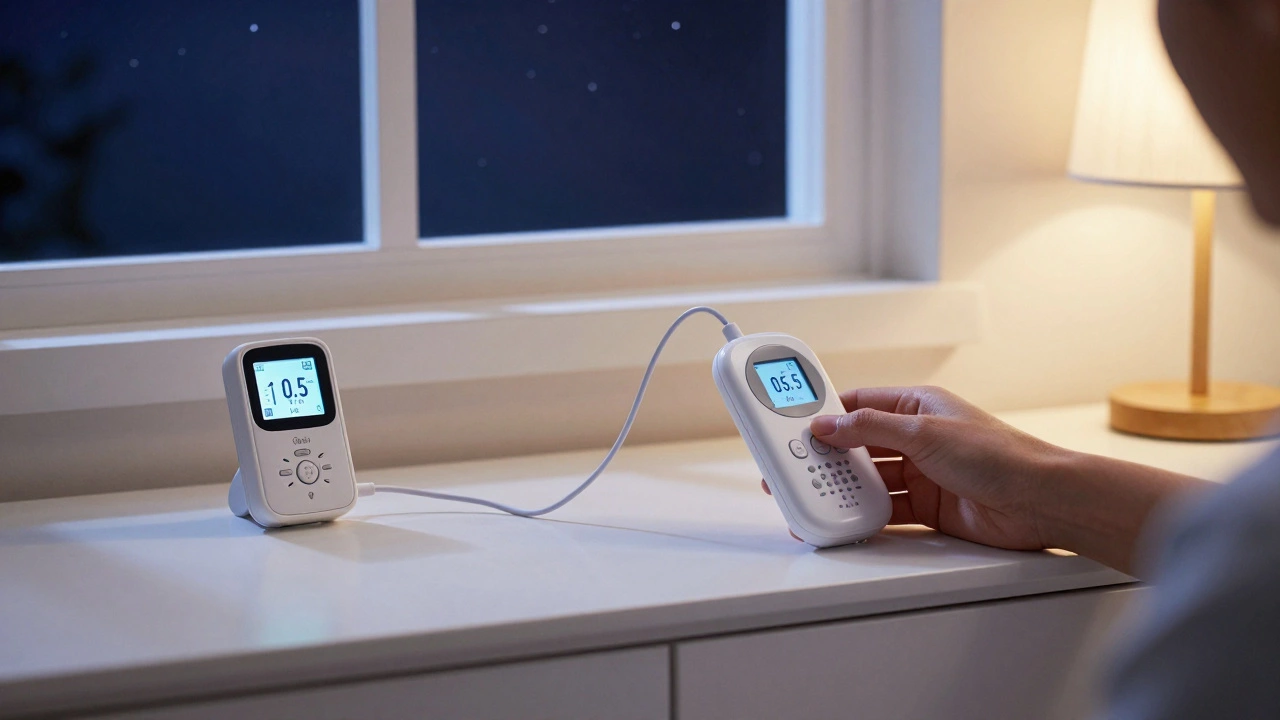
Wired baby monitors exist, though they’re rare. These models use a physical audio cable between the nursery and the parent unit - no wireless signal at all. They eliminate RF exposure completely. They’re less convenient (you can’t move around the house), but if you’re concerned about radiation, they’re the safest option. Brands like VTech and HelloBaby offer wired models, though you’ll need to search specifically for them.
Do all baby monitors emit radiation?
Only wireless models do. Analog audio monitors that use a simple radio signal still emit RF radiation. Digital monitors, especially those with Wi-Fi or video, emit more. But even the most basic wireless monitor - the kind that just plays sound - transmits radio waves. If it connects without a cord, it emits radiation. The only exception is a wired monitor with no wireless components at all.
How can I check how much radiation my monitor emits?
You can buy an EMF meter for under $50. These devices measure radiofrequency fields in volts per meter (V/m). Point it at the monitor’s base station from 10 cm away - if it reads above 1 V/m, you’re in the higher range. Most monitors read between 0.2 and 1.5 V/m at 30 cm. Move it to 1 meter away and check again. You’ll likely see a drop of 70-90%. That’s how much distance helps.