
Outdoor Security Light Longevity Estimator
Estimate Your Security Light's Lifespan
Based on industry standards and real-world testing. Blue LEDs have the longest theoretical lifespan, but build quality matters more than color.
Estimated Lifespan
Estimated operational years
When you’re buying outdoor security lights, you don’t just want bright light-you want light that lasts. No one wants to climb up a ladder every year to replace burnt-out bulbs. So, what color LED actually lasts the longest? The answer isn’t what most people assume, and it’s not white-even though that’s what most security lights use.
Blue LEDs Outlast Every Other Color
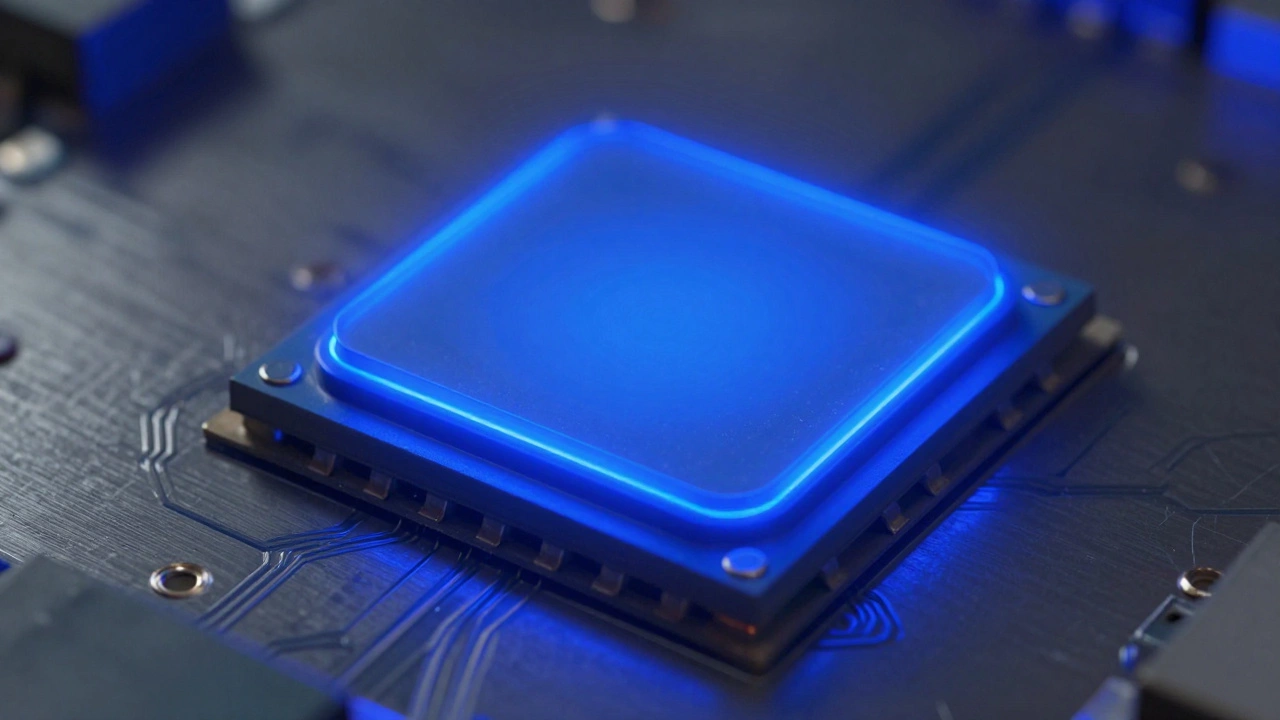
Among all LED colors, blue LEDs last the longest. Not because they’re brighter or more popular, but because of how they’re built. Blue LEDs use gallium nitride (GaN) semiconductors, which handle heat and electrical stress better than the materials used in red, green, or white LEDs. In controlled lab tests, high-quality blue LEDs maintain at least 70% of their original brightness after 100,000 hours of continuous use. That’s over 11 years of running 24/7.
Compare that to white LEDs, which typically last around 25,000 to 30,000 hours under the same conditions. Why the big difference? White LEDs aren’t pure LEDs-they’re blue LEDs coated with a yellow phosphor that mixes to make white light. That phosphor breaks down over time, especially when it gets hot. This is the main reason white LEDs dim faster. Blue LEDs skip the phosphor entirely. No coating means fewer things to fail.
Why Other Colors Don’t Hold Up
Red LEDs, often used in warning lights or indicators, use aluminum gallium arsenide (AlGaAs). They’re decent-lasting 50,000 to 70,000 hours-but they’re more sensitive to moisture. If your outdoor light isn’t sealed perfectly, humidity creeps in and speeds up degradation. In tests, red LEDs lost 25% more brightness than blue ones in high-humidity environments.
Green LEDs? They’re the weakest link. Due to what’s called the “green gap” in semiconductor physics, green LEDs need more current to produce the same brightness as blue or red. More current means more heat, which causes tiny metal wires inside the LED to break down faster through a process called electromigration. Most green LEDs top out at 35,000 hours, even in ideal conditions.
And while you might see blue LED strips advertised for backyard decor, those are often low-quality products. Don’t confuse cheap holiday lights with industrial-grade blue LEDs. The ones used in streetlights, warehouse indicators, or security floodlights are built to military-grade standards. Those are the ones hitting 100,000-hour lifespans.
But Here’s the Catch: Your Light Isn’t Just the LED
Here’s where things get tricky. Just because the LED chip inside lasts 100,000 hours doesn’t mean your whole security light will. Most outdoor security lights fail long before the LED does-not because of color, but because of bad design.
Drivers (the tiny power supplies inside the fixture) are the #1 cause of failure. Cheap drivers overheat, surge, or corrode. A $20 security light with a great blue LED but a $2 driver will die in 2 years. A $150 light with a quality driver and proper heat sinking? It’ll last 15+ years.
Thermal management matters more than color. If the LED gets too hot-above 85°C-its lifespan drops by 20-30% for every 10°C increase. That’s true for blue, white, or red. A well-ventilated fixture with aluminum heat sinks can make a white LED last almost as long as a blue one. That’s why professional installers don’t pick lights by color-they pick them by heat dissipation, IP rating, and driver quality.
Real-World Experience: What People Are Seeing
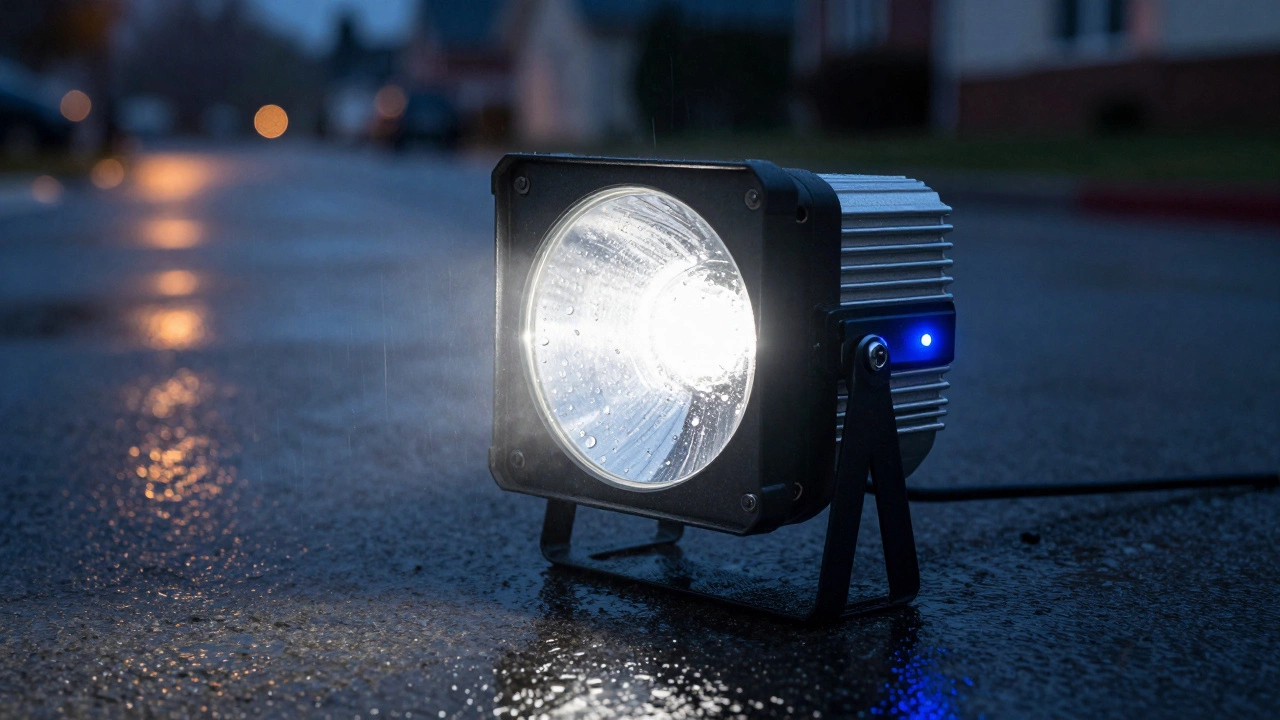
Electrical engineers who maintain industrial sites report something consistent: blue indicator lights on machinery last 2-3 times longer than white ones. One technician in Adelaide tracked a blue LED status light on a security panel that ran nonstop for 92,000 hours-over 10 years-and it was still at 85% brightness. The white LED lights in the same building? Half had failed by 40,000 hours.
But here’s the flip side: people who buy cheap blue LED decorative strips online often complain they dim faster than red or green. Why? Because those aren’t true blue LEDs-they’re low-grade chips with poor drivers and no heat control. They’re designed for 2,000-5,000 hours of occasional use, not constant outdoor operation.
Bottom line: The color advantage only matters if the rest of the system is built right.
What Should You Buy for Outdoor Security?
If you’re shopping for outdoor security lights, don’t waste time chasing “longest-lasting color.” Instead, focus on these three things:
- Driver quality - Look for lights with constant-current drivers from brands like Mean Well or Philips. Avoid no-name brands with no specs listed.
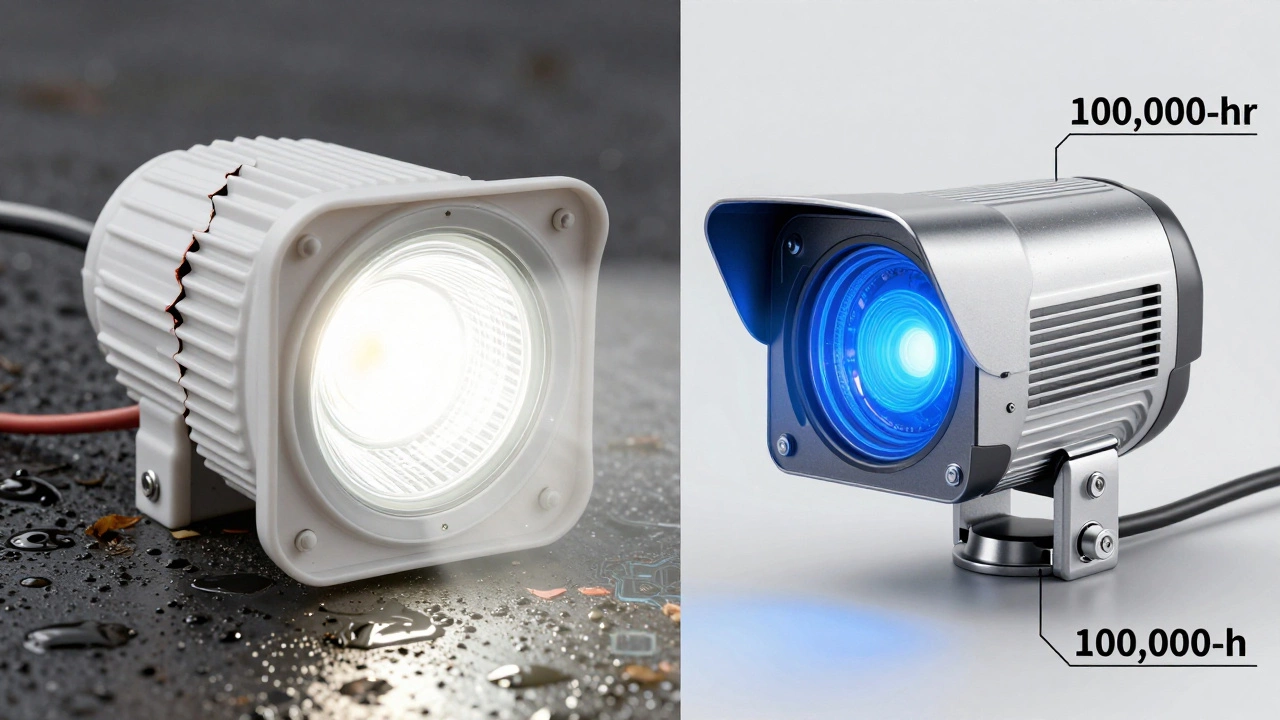
- Thermal design - The fixture should have visible aluminum heat sinks, not plastic housings. If it feels light, it’s probably not built to last.
- IP rating - Go for IP65 or higher. Dust and water are bigger killers than LED color.
Most top-rated outdoor security lights today use white LEDs-not because they last longer, but because they’re more practical. But if you find a white LED light with a high-quality driver, excellent heat sinking, and a 5-year warranty, it’s going to outperform a cheap blue LED light every time.
There’s one exception: if you’re installing a standalone indicator light-like a motion-sensor beacon or a status light on a gate control box-go with a pure blue LED. Those are built for longevity and rarely have drivers that fail. They’re the only place where color actually makes a measurable difference.
The Future: It’s Not About Color Anymore
Manufacturers are catching on. Samsung’s new “CrystalBlue” phosphor tech is making white LEDs last up to 90,000 hours. Research labs are testing micro-LED arrays with built-in temperature sensors that adjust power on the fly to keep all colors running evenly. The goal isn’t to find the longest-lasting color-it’s to make every color last as long as possible.
Regulations are changing too. The EU now requires all general lighting products to last at least 50,000 hours, regardless of color. That’s pushing everyone to improve thermal design, not just swap LED chips.
In 5 years, the difference between blue and white LED lifespan will be barely noticeable-if it exists at all. The real winners will be the lights built to handle heat, moisture, and power surges.
Final Takeaway
Blue LEDs have the longest theoretical lifespan-no doubt about it. But in the real world, your outdoor security light’s longevity depends on the driver, the heat sink, and the build quality-not the color of the light. Buy a well-made white LED light with a solid warranty, and you’ll be fine. If you want to maximize lifespan in a niche application like a status indicator, go blue. But don’t expect a blue bulb in a cheap plastic housing to outlast anything. The color doesn’t save a bad product.
For outdoor security, choose reliability over color theory. Build quality wins every time.