
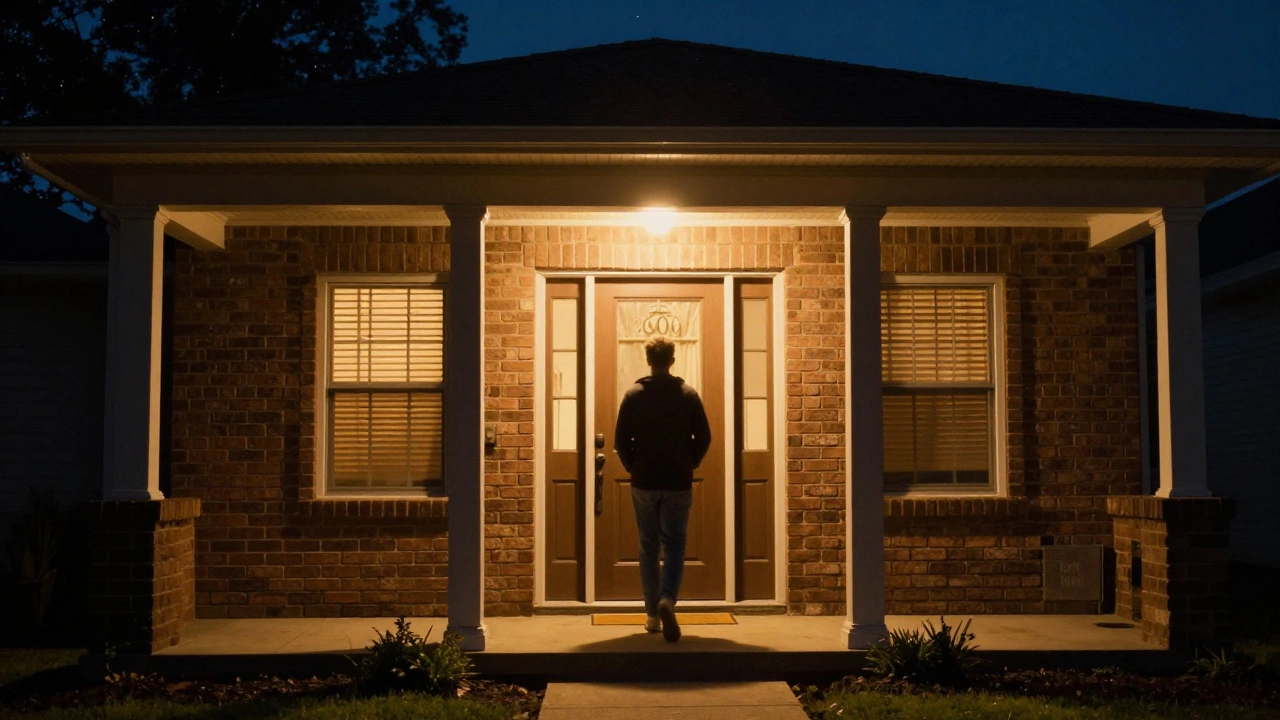
Outdoor Security Lighting Color Temperature Selector
Find the perfect color temperature for your outdoor security lighting based on your location and needs. Choose wisely to balance visibility, comfort, and neighborhood harmony.
Recommended Color Temperature
Important Warning
Avoid mixing color temperatures within 200K of each other in the same zone. This creates a patchy, unprofessional look that 41% of homeowners regret. Stick with one temperature for your entire property.
When you’re picking out outdoor security lights, the color isn’t just about looks-it affects how well you see at night, how your neighbors feel, and even your sleep. Too many people grab the brightest, bluest bulb they can find, thinking it’s the safest choice. But that’s often the worst move. The best color for outdoor security lighting isn’t the brightest. It’s the one that gives you clear vision without turning your yard into a hospital ward.
Why Color Temperature Matters More Than You Think
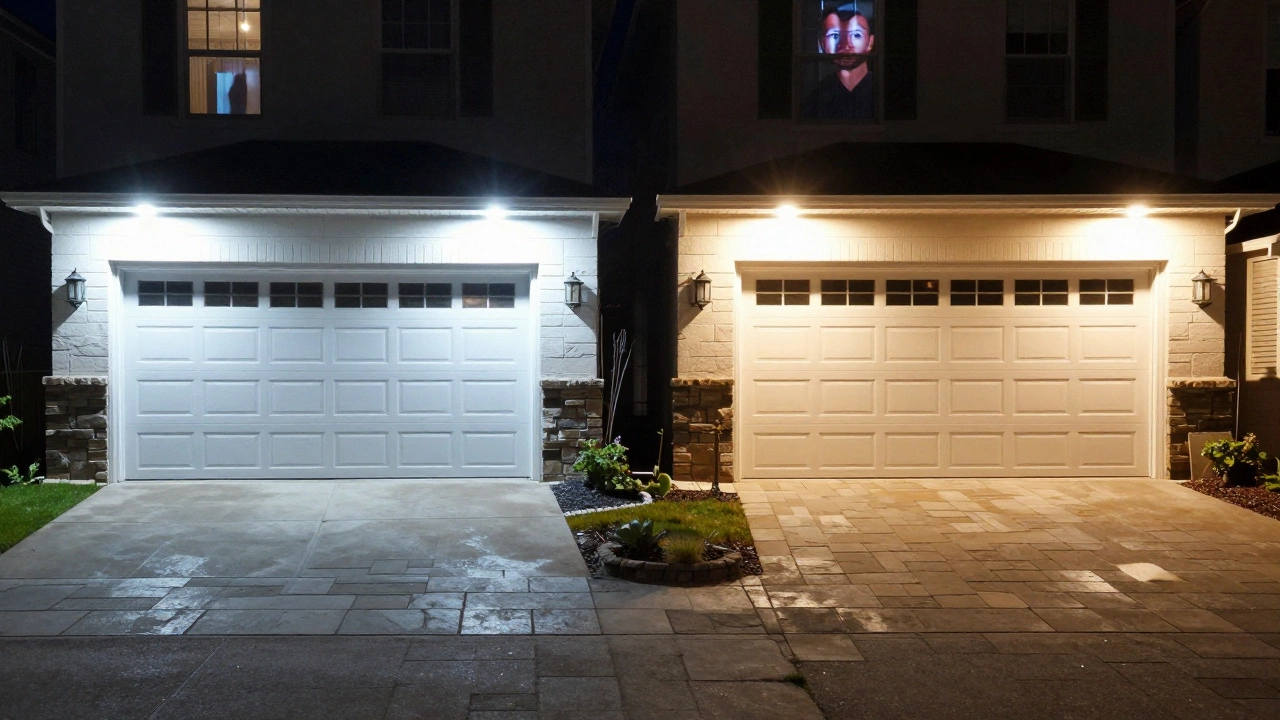
Outdoor lighting color is measured in Kelvin (K), not watts or lumens. Lower numbers mean warmer, yellower light. Higher numbers mean colder, bluer light. Most LED security lights fall into three buckets: 2700K-3200K (warm white), 3500K-4000K (neutral white), and 5000K-6500K (cool white). You’ll see 5000K labeled as "daylight" on the box. It looks like midday sun, but at night? It’s harsh. It’s glaring. And it’s the reason your neighbors are filing complaints.Here’s the truth: 92% of homeowners who install outdoor lighting choose warm white. That’s not a coincidence. It’s because warm light feels natural. It doesn’t wash out faces on your security camera. It doesn’t make shadows look like monsters. And it doesn’t blind you when you walk out to get the mail at 2 a.m.
The 3000K Sweet Spot for Security and Comfort
If you want one number to remember, make it 3000K. It’s the middle ground that works for almost everyone. At 3000K, the light is warm enough to feel inviting but bright enough to clearly show faces, license plates, and movement. Field tests by Washington Outdoor Lighting found that 3000K-4000K lighting improves object recognition by 15-20% compared to warmer options. That’s not just theory-it’s real-world visibility.At the same time, 3000K produces 45% less glare than 5000K, according to Super Bright LEDs. That means less light spilling into your neighbor’s windows. Less light bouncing off your driveway into their eyes. Less reason for them to call the HOA.
On Reddit’s r/Landscaping, 78% of users who switched from 4000K or 5000K to 3000K reported their neighbors stopped complaining. One user, u/LandscapePro99, wrote: "I switched from 4000K to 3000K on my front path and neighbors stopped complaining about the harsh light." That’s the kind of feedback you can’t buy.
Why 5000K Is a Bad Idea for Homes
You might think: "But 5000K is brighter! Better for security!" It’s not that simple. Yes, 5000K light covers 12% more area per fixture. But here’s the catch: your eyes don’t see it better. In fact, the human eye is less sensitive to blue light at night. What feels bright is actually less useful for detail recognition.And then there’s the cost-literally. 5000K lighting contains 32% more blue light than 3000K, which the Illuminating Engineering Society says disrupts circadian rhythms. That means if you leave a 5000K light on near your bedroom window, you’re not just lighting your yard-you’re messing with your sleep. Studies show this increases the risk of insomnia and reduces melatonin production.
Also, 61% of service callbacks for outdoor lighting come from people who picked 5000K and regretted it. They thought it was safer. Turns out, it just made their property look like a warehouse parking lot. And in 17 U.S. states, including California, New York, and Illinois, it’s now illegal to install 5000K+ lighting in residential zones. That’s not a suggestion. That’s the law.
What About Warm White (2700K-3200K)?
If you’re thinking 3000K is too cold, go warmer. 2700K-3200K is the new industry standard. The Illuminating Engineering Society updated its 2024 guidelines to recommend 2700K-3000K as the maximum for new residential builds. Why? Because it reduces skyglow by 27% compared to 5000K. It’s better for wildlife. It’s better for your neighbors. It’s better for your eyes.Philips announced in October 2023 they’re phasing out 5000K outdoor fixtures for homes by Q3 2025. They’re doubling down on 2700K-3000K lines. That’s not marketing fluff. That’s the industry moving.
And here’s the secret: 2700K doesn’t mean dim. It means soft. It means your front porch looks like it’s lit by candlelight, but still lets you see who’s standing there. It’s the color of a campfire. Of a warm lamp in a living room. Of a home.
How to Pick the Right Color for Your Home
Don’t guess. Test it. Most lighting stores have sample fixtures you can turn on in-store. Stand next to them. Look at your own house’s materials-brick, stone, wood. Warm light brings out the reds and browns in stone. Cool light turns them gray and flat.Use this simple guide:
- 2700K-3000K: Best for front porches, patios, walkways, and areas near bedrooms. Use this if you want to feel safe without feeling stared at.
- 3500K-4000K: Good for driveways, garages, and backyards where you need a bit more clarity. Use this if you have security cameras and want better facial recognition.
- Avoid 5000K+: Save this for warehouses, gas stations, or commercial lots. Not your home.
Pro tip: Keep your entire property within 200K of each other. If you have a 3000K light on the front and a 5000K light on the side, your yard will look patchy and cheap. That’s why 41% of unhappy homeowners say their lighting looks "inconsistent." It’s not the lights-it’s the mismatch.

What the Experts Say
Michael Sheridan, CEO of Northwest Outdoor Lighting with 18 years in the business, says: "2700K to 3200K is the optimal range for ALL exterior residential lighting." His company installs 87% of their residential lights in that range. No exceptions.Dr. Elena Rodriguez from the Illuminating Engineering Society says 3500K-4000K is best for urban areas because it cuts light pollution by 18% while keeping visual clarity. But she also warns: "Never go above 4000K in a residential zone."
And James Peterson, Total Light’s landscape director, recommends mixing: "Use 2700K for dining areas, 3000K for pathways, and 4000K for architectural accents." That’s how you get both function and beauty.
What’s Changing in 2026
By 2027, 78% of new residential outdoor lighting installations will be 2700K-3000K, according to Rensselaer Polytechnic Institute. That’s up from just 52% in 2023. Why? Because people are waking up to the fact that bright blue light isn’t safer-it’s just annoying.Manufacturers are catching on. Retailers are pulling 5000K fixtures from home aisles. Cities are tightening ordinances. Even Amazon reviews show a shift: 5000K security lights have higher ratings, but 63% of those reviews mention "better camera visibility," not "better safety." That’s not the same thing.
The real security win? A well-lit path, a clear view of your door, and a light that doesn’t make your whole neighborhood squint. That’s not about brightness. It’s about balance.
Final Answer: Go with 3000K
The best color for outdoor security lighting in 2026 is 3000K. It’s the sweet spot between visibility and comfort. It’s what professionals use. It’s what the law is moving toward. It’s what your neighbors will thank you for.Don’t overthink it. Don’t chase the brightest bulb. Pick 3000K LED fixtures. Install them at key points-front door, garage, back steps. Keep everything consistent. And sleep easy knowing your yard is secure, not blinding.
Is 5000K better for security cameras?
5000K light does improve camera clarity slightly because it’s closer to daylight, but the difference is minimal-about 5-8% better detail. That’s not worth the trade-offs: glare, neighbor complaints, disrupted sleep, and higher blue light pollution. Most modern security cameras have infrared night vision and low-light sensors that work perfectly with 3000K. You don’t need blue light to see clearly on camera.
Can I mix different color temperatures in my yard?
Yes, but only if you’re intentional. Use 2700K for seating areas and porches to create warmth. Use 3000K for pathways and entryways where you need clear visibility. Use 4000K only for architectural features like columns or trellises that need accent lighting. Never mix 3000K and 5000K in the same zone. That creates a patchy, unprofessional look that 41% of homeowners regret.
What’s the difference between lumens and color temperature?
Lumens measure brightness-how much light the bulb gives off. Color temperature (Kelvin) measures hue-whether the light looks warm yellow or cool blue. A 800-lumen bulb at 2700K and one at 5000K both give the same brightness, but they look completely different. You can have a bright 3000K light that’s more useful than a dim 5000K one.
Are warm white lights less energy efficient?
No. LED efficiency isn’t affected by color temperature. A 3000K LED uses the same power as a 5000K LED with the same lumen output. The difference is in the phosphor coating inside the bulb, not the electricity used. So you’re not sacrificing efficiency for warmth.
Should I replace my existing 4000K lights with 3000K?
If your 4000K lights are causing glare, making your yard look harsh, or drawing complaints, then yes. 4000K is still acceptable for driveways and garages, but for front yards and near windows, 3000K is better. You don’t need to replace everything at once. Start with your front porch and back patio-the areas you use most. Then replace others as bulbs burn out.