
Night Vision Camera Selector
Answer three simple questions to find the best night vision technology for your situation.
You’re standing in your backyard at 2 AM. It’s pitch black. You pull out your phone or check a monitor, and you see… nothing. Or maybe you see grainy gray shapes that look more like static than a person. This is the most common frustration with home security: "Does this camera actually work when the lights are off?" The short answer is yes, but not all night vision is created equal. When people ask what kind of cameras have night vision, they usually assume there’s one magic technology. In reality, there are five distinct ways a camera sees in the dark, and picking the wrong one can mean the difference between identifying an intruder’s face and just seeing a heat blob.
The Core Problem: Seeing Without Light
To understand which camera fits your needs, you first need to grasp how light works. Human eyes see visible light. Most standard cameras do too. But at night, visible light disappears. To compensate, engineers developed three main strategies: add invisible light (Infrared), amplify tiny amounts of existing light (Image Intensification), or detect heat instead of light (Thermal). Your choice depends entirely on what you need to see. Do you need color evidence? Do you need to see through smoke? Or do you just need to know if something moved?
Quick Summary / Key Takeaways
- Infrared (IR) Cameras: Best for general home security. They use LEDs to light up the scene invisibly. Great for faces and license plates, but footage is black-and-white.
- Low-Light/Starlight Cameras: Use large sensors to capture color video in dim conditions (like streetlights). They fail in total darkness unless paired with white lights.
- Thermal Cameras: Detect heat signatures. Perfect for spotting people hidden by bushes or in complete darkness, but poor for facial recognition.
- Image Intensifiers: Military-grade tech that amplifies ambient starlight/moonlight. Expensive and sensitive to bright flashes.
- Hybrid Systems: Combine thermal detection with visual identification. Ideal for professional security where both alerting and verifying matter.
Infrared (IR) Cameras: The Standard for Home Security
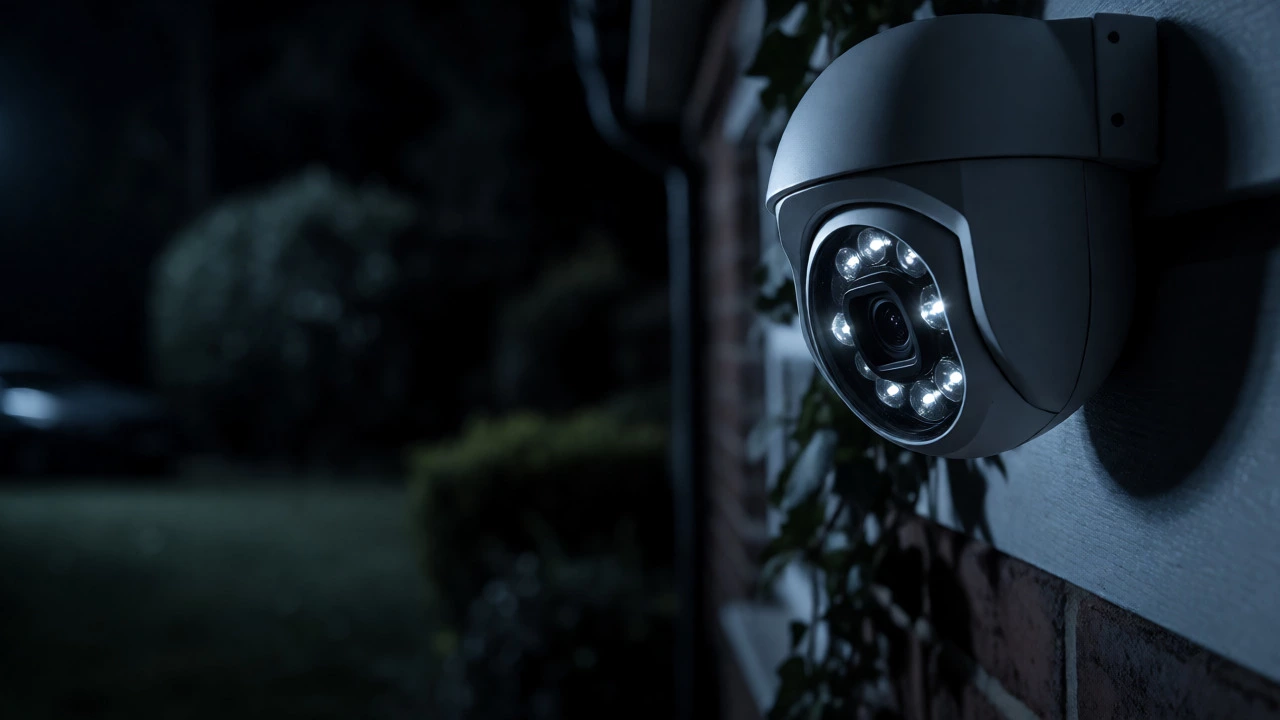
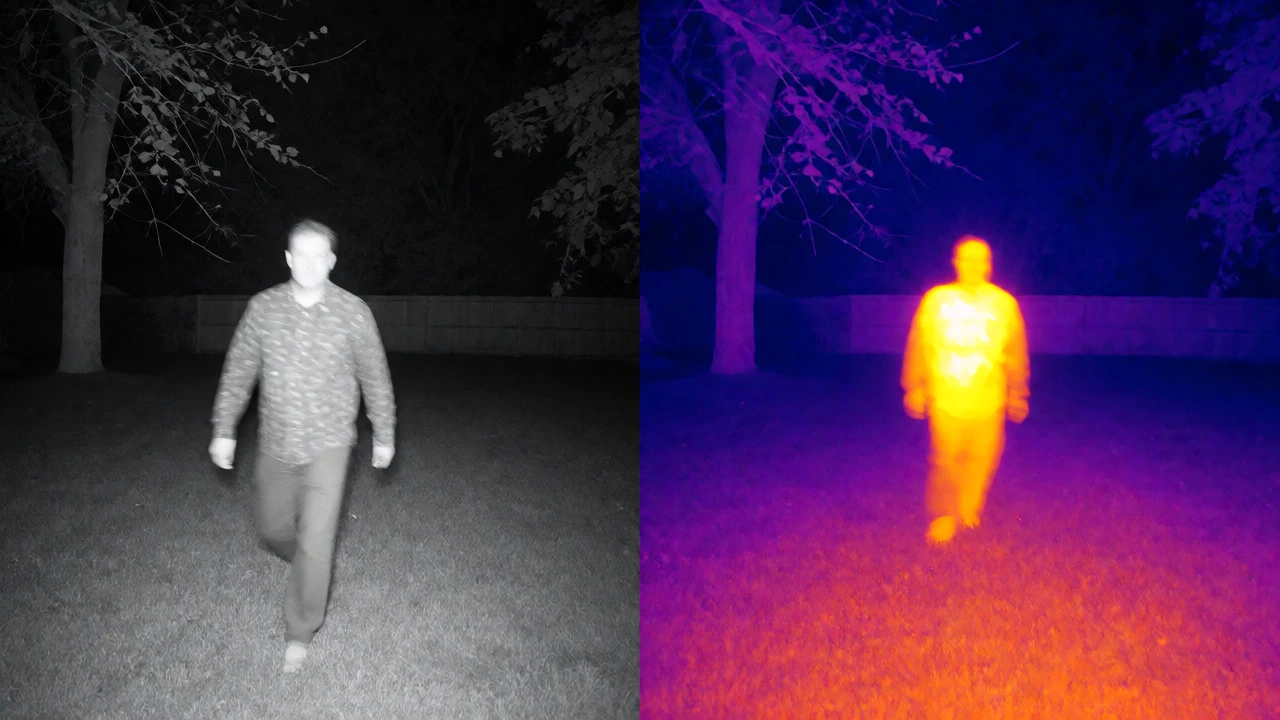
If you buy a standard outdoor security camera from Reolink, Axis, or Hikvision, it almost certainly uses near-infrared (NIR) illumination. These are technically "day/night" cameras. During the day, an internal filter blocks infrared light so colors look normal. At night, that filter physically moves aside, the sensor switches to monochrome mode, and built-in LEDs blast the area with invisible light around 850nm or 940nm wavelengths. This technology is dominant because it’s affordable and effective for identifying details. If someone walks into your driveway, an IR camera can show their clothing texture, whether they’re carrying a bag, and often their face. However, it has limits. The light doesn’t go far-most consumer IR LEDs reach only 30-50 meters (100-160 feet). Beyond that, the image fades to black. Also, IR light reflects off glass, so placing these cameras behind windows often results in glare rather than clarity. And yes, those little red dots you sometimes see on cheap cameras? That’s the LED leaking visible light. Higher-end 940nm illuminators are totally invisible but require more power for the same range.
Digital Low-Light and "Starlight" Cameras
Marketing terms like "Starlight," "ColorVu," or "Full-Color Night Vision" refer to digital low-light processing. These cameras don’t necessarily add infrared light. Instead, they use larger image sensors and wider aperture lenses to soak up whatever ambient light exists-moonlight, distant streetlamps, or porch lights. Some models also use computational photography to boost brightness and reduce noise without switching to black-and-white. Why would you choose this over IR? Color matters. If you’re trying to identify a vehicle, knowing it was a red sedan versus a blue truck is crucial evidence. IR strips color away; low-light cameras keep it. But here’s the catch: these cameras are terrible in absolute darkness. If the moon is covered by clouds and there are no streetlights nearby, a "starlight" camera will produce a noisy, unusable mess unless it activates a white-light spotlight. Many modern units, like certain Reolink or Dahua models, switch automatically: they try low-light color first, then flip to IR if it gets too dark. This hybrid approach gives you the best of both worlds, but it relies on having *some* initial light source.
Thermal Imaging: Seeing Heat, Not Light
Thermal cameras operate on a completely different principle. They don’t care about visible light or reflected infrared. They detect mid-wave and long-wave infrared radiation emitted by objects based on their temperature. This means thermal cameras work in 100% darkness, fog, smoke, and even light rain. They are passive, meaning they emit no light themselves, making them impossible for an intruder to spot. The trade-off is resolution and detail. A thermal image shows hot spots against a cooler background. You can easily tell if a person is hiding in dense brush because their body heat stands out against the cold leaves. But you cannot read a license plate or recognize a face. The image looks like a blurry heat map. Thermal is expensive compared to IR, but it’s unbeatable for perimeter detection. If you live on a large property with woods or fields, a thermal camera can alert you to movement hundreds of yards away, even if a standard IR camera sees nothing but black trees. Note that thermal cameras cannot see through glass. Glass reflects thermal energy, so pointing a thermal cam out a window just shows you the reflection of your own room.
Image Intensification: The Military Grade Option
Think of the classic green-tinted goggles used by soldiers. That’s image intensification. These devices take photons (from stars, moonlight, or sky glow) and convert them into electrons, multiply the signal, and project it back as a brighter image. Unlike IR cameras, they don’t need to shine a light on the target, so they are covert. Unlike thermal cameras, they provide recognizable visual detail-you can navigate terrain and identify objects clearly. However, true image-intensified cameras are rare in consumer home security due to cost and complexity. They are mostly found in high-end tactical gear, specialized wildlife monitoring, or premium drone payloads. They struggle in total darkness (no photons to amplify) and can be temporarily blinded by headlights or flashlights. For the average homeowner, this technology is overkill and impractical. But if you need detailed observation in low-light scenarios where active illumination (IR LEDs) might give away your position, this is the specialist tool.
Hybrid and Multispectral Systems
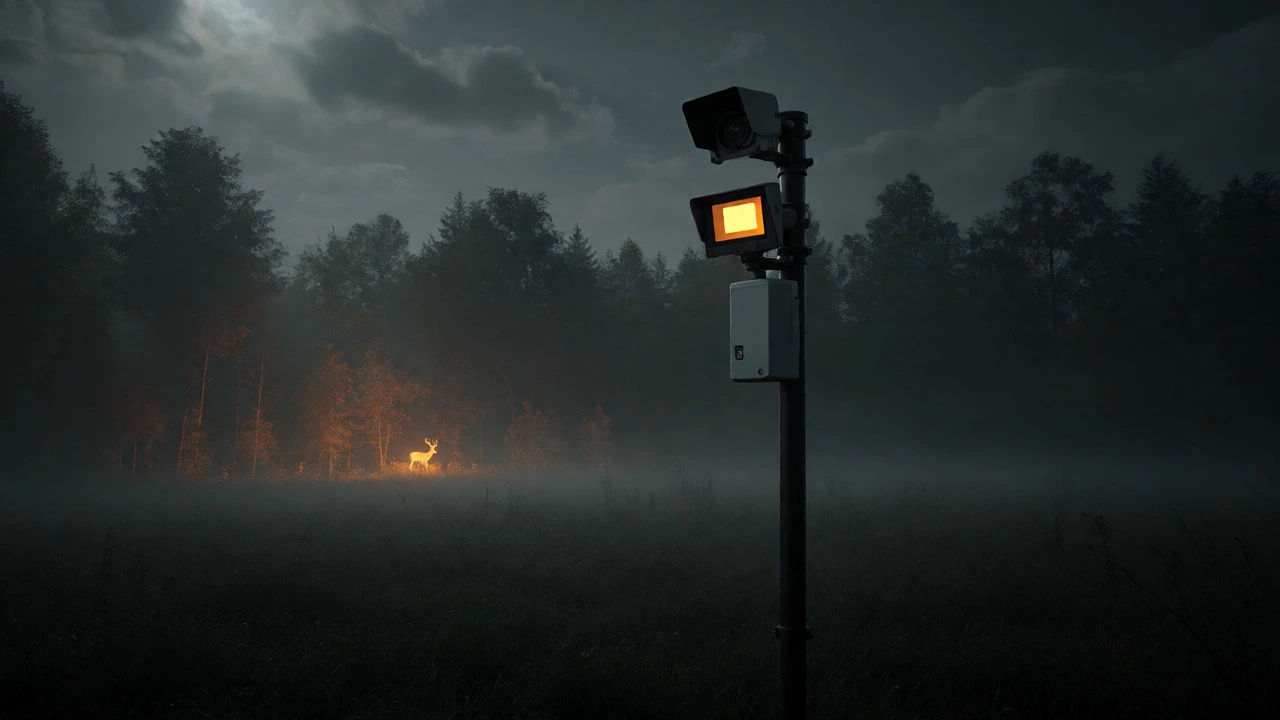
For critical infrastructure, military bases, or high-value homes, single-sensor solutions aren’t enough. Hybrid cameras combine two sensors: a thermal imager for wide-area detection and a high-resolution visible/IR camera for verification. The system works in tandem. The thermal sensor scans a wide area and detects a heat signature. Once it flags a potential threat, the visible-light camera zooms in to get a clear picture of the face or license plate. This fusion solves the biggest weakness of thermal (lack of detail) and the biggest weakness of IR (limited range and lack of stealth). These systems are complex and expensive, often costing thousands of dollars per unit. They require more power and careful calibration. But for scenarios where false alarms are costly or where you need to track targets across vast distances regardless of lighting conditions, hybrids are the gold standard.
Choosing the Right Camera for Your Scenario
So, which one should you buy? Let’s break it down by real-world use cases.
| Feature | Infrared (IR) | Low-Light (Starlight) | Thermal | Image Intensifier |
|---|---|---|---|---|
| Best For | General home security, faces, plates | Color evidence, urban areas with streetlights | Perimeter detection, fog/smoke, hunting | Tactical ops, covert observation |
| Total Darkness | Yes (with IR LEDs) | No (needs some ambient light) | Yes | No (needs starlight/moonlight) |
| Color Output | No (Monochrome at night) | Yes | No (False color/grayscale) | Usually Green/White phosphor |
| Cost | $ (Affordable) | $$ (Mid-range) | $$$ (Expensive) | $$$$ (Very Expensive) |
| Range | Short-Medium (30-100m) | Medium (depends on lens) | Long (500m+) | Medium-Long |
- Suburban Homeowner: Go with a Day/Night IR camera. It’s cheap, reliable, and gives you the facial detail needed to identify neighbors or delivery drivers. Look for models with 850nm LEDs for better range.
- Urban Apartment/Street View: Choose a Low-Light/Starlight camera. Streetlights provide enough ambient light for color footage, helping you distinguish between cars and people more naturally.
- Rural Property/Wooded Lot: Consider Thermal or a Hybrid. IR won’t penetrate deep woods well, and you’ll miss animals or intruders moving silently in the dark. Thermal cuts through the visual clutter of branches.
- Business Warehouse: Hybrid or PTZ IR. You need coverage of large open spaces. PTZ (Pan-Tilt-Zoom) cameras with powerful IR arrays can cover huge areas, while thermal adds a layer of intrusion detection.
Common Pitfalls and Pro Tips
One major mistake is assuming "night vision" means you can see forever. Physics still applies. An IR camera rated for 100 meters will struggle to resolve a face at 80 meters because the light spreads out and weakens. Another issue is reflective surfaces. Wet pavement or car windshields can bounce IR light directly back into the lens, washing out the image. Position your cameras slightly above eye level and angled down to minimize this glare. Also, beware of marketing hype. If a box says "Color Night Vision," check if it requires a white light spotlight. Many do. While helpful, a bright white light defeats the purpose of covert surveillance. If you want stealth, stick to IR or Thermal. Finally, remember that spiders love IR LEDs. Their webs reflect the light beautifully, creating glowing threads that trigger motion alerts constantly. Regular cleaning or using cameras with spider-web reduction algorithms helps mitigate this annoyance.
Do all security cameras have night vision?
No. Basic indoor cameras often lack infrared LEDs and rely solely on ambient room light. If the room is dark, they see nothing. Always check specs for "IR Range" or "Minimum Illumination" before buying.
Can thermal cameras see through walls?
No. Thermal cameras detect surface temperature. They cannot see through solid walls, though they might detect heat leakage through thin materials or gaps. They definitely cannot see through glass.
Why is my night vision footage blurry?
Blurry night footage is usually caused by motion blur (slow shutter speed in low light), dirty lenses, or condensation/fog on the camera housing. Ensure your lens is clean and consider cameras with faster shutter speeds or better stabilization.
Is 850nm or 940nm IR better?
850nm offers longer range and higher sensitivity but emits a faint red glow. 940nm is completely invisible to the human eye but requires more power and has shorter range. For most homes, 850nm is preferred for its performance-to-cost ratio.
Can I upgrade my old camera to have night vision?
Generally, no. Night vision capability is hardware-dependent (sensor type, filter mechanism, LED array). You cannot simply install software to enable it. You’d need external IR floodlights, but the camera sensor must also be sensitive to NIR wavelengths.