
Dog Alarm Sound Frequency Calculator
Enter your alarm frequency (in Hz) to see if it triggers dog howling and estimate training success.
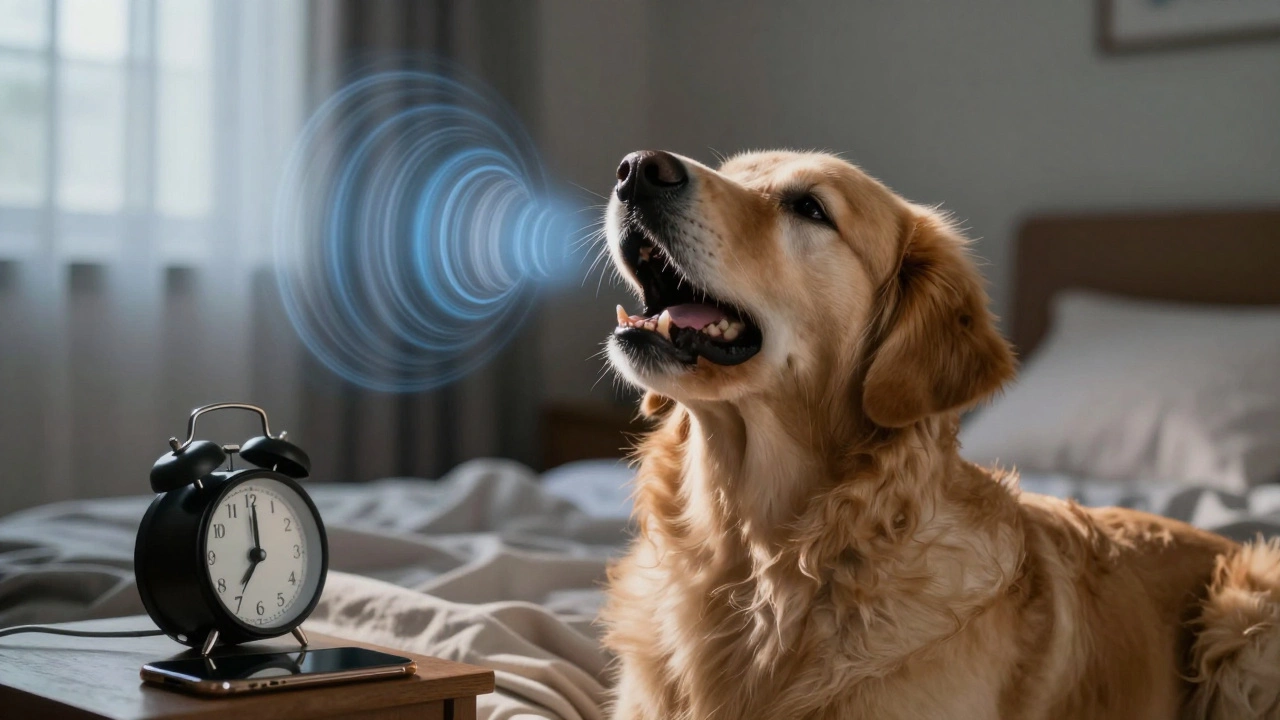
Ever wake up to your dog howling like a wolf at your alarm clock? You’re not alone. Around 65% of dogs react to alarm sounds with vocalizations - whether it’s a high-pitched beep, a buzzing ringer, or even your phone’s alarm tone. It’s not just annoying. It’s confusing. Why does your dog react so strongly to something that’s just part of your morning routine?
It’s Not About the Alarm - It’s About the Sound
Your dog doesn’t understand that the alarm is meant to wake you up. To them, it’s just a loud, sudden, high-pitched noise. Dogs hear frequencies between 67 Hz and 45,000 Hz. Humans? We max out around 20,000 Hz. That means your alarm clock - typically blasting between 2,000 and 4,000 Hz - is hitting your dog’s sweet spot for hearing. It’s not just loud. It’s piercing.Think of it like this: if you heard a sound that only you could hear, and it was sharp enough to make your teeth ache, you’d react too. Dogs don’t have the same filters we do. Their ears have 18 muscles that let them pinpoint where a sound comes from within 4 degrees. That’s why they react so fast - and so loudly.
Why Do They Howl? Instinct, Not Malice
Dogs don’t howl because they’re trying to be annoying. They’re following an ancient instinct. Wolves howl to communicate over long distances - to gather the pack, signal danger, or just say, “I’m here.” Your dog hears that alarm and thinks: Something’s happening. Is this the pack calling? Should I respond?It’s not always about communication, though. For some dogs, it’s fear. A sudden noise triggers a stress response. Their body goes into alert mode. Howling is their way of releasing tension. Others see it as a territorial warning - like a stranger knocking on the door. They’re announcing, “I’m here to protect this space.”
Studies show that breeds like Siberian Huskies (87% reaction rate) and German Shepherds (63%) are far more likely to howl than Bulldogs (22%). That’s not just personality - it’s genetics. Some dogs are wired to respond to high-pitched sounds. Others? Not so much.
Alarm vs. Other Noises: What’s Different?
Not all loud noises trigger the same reaction. A siren? That’s a mystery. A thunderclap? That’s chaos. But an alarm clock? It’s predictable. It goes off at the same time every day. That’s why it’s so confusing for dogs - and for you.Here’s the key difference: when dogs howl at sirens, it’s usually intense and lasts longer. Alarm-related howling? It’s shorter - about 15 to 45 seconds - and stops almost immediately after the alarm cuts off. That tells us something important: it’s not fear-driven panic. It’s more like a reflex. A conditioned response.
And here’s the kicker: dogs who react to alarms are 3.2 times more likely to have noise sensitivity disorders. That means if your dog shakes, hides, or pees when the alarm goes off, it’s not just “being dramatic.” It’s a real issue.
What Doesn’t Work (And Why)
Too many owners try to stop the howling by yelling, clapping, or even scolding their dog. That might work for a second - but it makes things worse long-term.Here’s why: when you yell, you’re adding another loud noise to the mix. Your dog hears: “Alarm goes off. Human yells. That’s scary.” Now the alarm isn’t just a noise - it’s linked to your anger. That increases anxiety. A 2021 survey by the American Veterinary Society of Animal Behavior found that 31% of dogs who were punished for alarm howling developed new fears - like trembling at the sound of any electronic device.
Even ignoring the behavior doesn’t help. Dogs don’t learn from silence. If they howl and nothing happens, they’ll just howl louder next time. They’re trying to get your attention - and if you don’t respond, they think they didn’t try hard enough.
What Actually Works: Training That Fits Their Brain
The most effective fix isn’t punishment. It’s reassociation.Here’s how to do it:
- Record your alarm sound. Use your phone to capture it at the exact volume you use.
- Play it at a volume so low your dog barely notices - maybe 10% of normal.
- The second the sound plays, give them a high-value treat. Chicken. Cheese. Something they only get during training.
- Wait 5 seconds. If they stay quiet, give another treat.
- Repeat this 3-5 times a day for 3 days.
- Gradually increase the volume by 5% each session. Don’t rush. If they react, go back to the last volume they handled.
This is called counter-conditioning. You’re teaching their brain: Alarm sound = good thing. Not scary. Not confusing. Not a threat. A treat.
Studies show this method works in 82% of cases within 7-10 days. Dogs who respond to this training stop howling completely - not just less often.
Switching Alarms: The Easy Fix
If training feels overwhelming, start with the alarm itself.Not all alarms are created equal. A sharp, sudden buzzer? That’s the worst. A gradual ramp-up alarm? That’s the best.
Research from the University of Pennsylvania found that alarms with a 30-second volume increase reduce vocalization by 42%. Why? Because the dog’s brain has time to adjust. It doesn’t get startled.
Try these alternatives:
- Sunrise alarms: Light-based alarms that gently brighten the room. Many dogs respond better to light than sound.
- Nature sounds: Gentle birdsong, ocean waves, or rainfall. These are lower frequency and less jarring.
- White noise alarms: These mask the alarm sound with steady background noise. They reduce vocalization by 52% compared to traditional alarms.
- Vibration alarms: Wearable devices that shake the bed or your phone. Only 28% of dogs react to these - but they’re not ideal if you need to hear it too.
Amazon reviews show that pet owners who switched to sunrise or nature-sound alarms saw immediate results. One user wrote: “My Beagle stopped howling the first morning I used the sunrise alarm. I didn’t even have to train her.”

When to See a Vet
If your dog suddenly starts howling at alarms when they never did before - or if they’re trembling, panting, or hiding - it’s time to check with your vet.Underlying issues like hearing loss, cognitive decline, or thyroid problems can change how dogs process sound. Older dogs, especially, may start reacting differently. A 2023 study found that dogs with early-stage hearing loss sometimes howl louder because they can’t hear themselves - and think they’re not being loud enough.
Also, if your dog reacts to all sudden noises - vacuum cleaners, doorbells, even a dropped spoon - they may have a noise anxiety disorder. That’s treatable, but it needs professional help. The FDA-approved transdermal patch Relievio showed 63% effectiveness in clinical trials for noise sensitivity. It’s not a cure, but it’s a tool.
The Bigger Picture: Why This Matters
This isn’t just about your morning routine. It’s about your dog’s mental health.Over 24.5% of dogs in the U.S. suffer from noise sensitivity. That’s nearly 18 million pets. The pet noise anxiety market hit $287 million in 2023. Why? Because more people are realizing: dogs aren’t just pets. They’re family. And their stress matters.
Urban dogs are 29% more likely to react to alarms than rural ones. Why? Constant exposure to electronic sounds - phones, microwaves, smart speakers - makes their nervous systems more reactive. It’s like living in a constant state of low-grade noise pollution.
And here’s the future: by 2030, experts predict that noise sensitivity training will be as standard as leash training. Smart collars like PetPace can now detect stress before a dog howls - and automatically lower your alarm volume. That’s not science fiction. It’s happening now.
Final Thought: It’s Not Their Fault
Your dog isn’t being stubborn. They’re not trying to ruin your day. They’re responding to a sound your brain ignores - but theirs can’t. Their reaction is real, biological, and rooted in thousands of years of evolution.Fixing it isn’t about controlling them. It’s about understanding them. Change the alarm. Change the association. Give them a reason to stay quiet. And in a week or two, you’ll wake up to silence - not howling.
Why does my dog howl only at my phone alarm and not my traditional alarm clock?
Phone alarms often use higher-pitched tones (up to 4,000 Hz) to cut through background noise, which dogs hear more clearly than lower-frequency buzzer alarms. Traditional alarm clocks usually emit sounds below 2,500 Hz, which are less irritating to dogs. Your dog isn’t reacting to the device - they’re reacting to the frequency. Try switching your phone alarm to a low-pitched tone or nature sound to test this.
Can I train my dog to ignore alarms without treats?
Treats are the most reliable tool because they create a strong positive association. Without them, your dog has no reason to change their behavior. You can try using toys, praise, or petting - but only if your dog is highly motivated by those things. For most dogs, food rewards work fastest. If you skip rewards, you’re relying on luck, not training.
Will my dog grow out of this behavior on its own?
No. This isn’t a phase. It’s a learned response. If nothing changes, your dog will keep howling - and may even start reacting to other sounds like doorbells or vacuum cleaners. The behavior strengthens with repetition. Without intervention, it gets worse, not better.
Is it safe to use noise-canceling headphones for my dog?
No. Dog headphones aren’t designed for long-term use and can cause ear damage or increased anxiety. They also don’t address the root issue - your dog’s emotional response to the sound. Instead of muffling the noise, focus on changing how your dog feels about it. That’s what training does.
How long does it take to stop a dog from howling at alarms?
Most dogs stop within 10-14 days of consistent counter-conditioning. Some respond in as little as 3-5 days if they’re highly food-motivated. The key is consistency - do the training at least twice a day. Missing days slows progress. If you don’t see improvement after 2 weeks, consider switching to a different alarm type or consulting a certified dog trainer.
Can medication help my dog stop howling at alarms?
Medication like the FDA-approved Relievio patch can help reduce anxiety in dogs with severe noise sensitivity - but only as a short-term tool. It doesn’t teach your dog to cope. It just makes them calmer while you train. Most vets recommend using it alongside behavior training, not instead of it. Never use human anxiety meds - they’re toxic to dogs.
What if my dog only howls when I’m not home?
That’s a sign of separation anxiety triggered by the alarm, not just noise sensitivity. The alarm becomes a cue that you’re leaving. In this case, you need to break the association between the alarm and your departure. Try setting the alarm 10 minutes before you leave and stay home during the training. Reward calm behavior even if you’re not going anywhere. Then slowly build up to leaving after the alarm.