
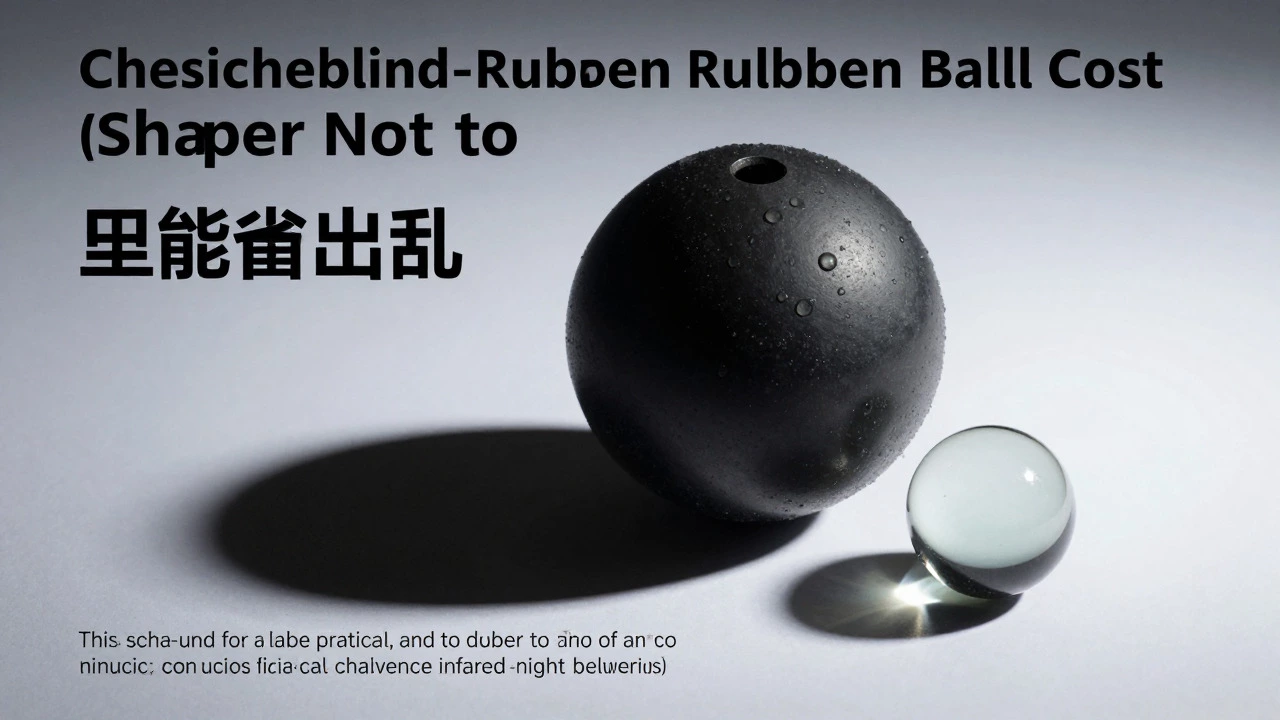
Shadow Contrast Simulator
Material Settings
Adjust light transmission to see how shadows change.
Human eyes need ~20% contrast difference to reliably detect a shadow.
Visual Simulation
Rubber is opaque. It blocks nearly all light, creating a dark "Umbra" shadow that is easily visible to the human eye and cameras.
You’ve probably seen it happen. You drop a rubber ball on the floor, and it casts a sharp, dark shadow. You pick up a glass marble or a clear sphere, hold it in the same spot, and... nothing? Or maybe just a faint, weird distortion. It looks like the glass ball is invisible to the light. This simple observation trips up students, teachers, and even seasoned photographers. But here is the twist that matters for your home security setup: this isn’t just a parlor trick of optics. It is the exact reason why night vision cameras sometimes fail to see intruders hiding behind fences, leaves, or rain.
The short answer is that the premise is slightly wrong. A glass ball does cast a shadow. It’s just not the kind of shadow your eyes are wired to notice. Understanding the difference between how rubber and glass interact with light is crucial if you want to understand how infrared (IR) night vision cameras work, why they struggle with certain materials, and how to position them to avoid blind spots.
The Myth of the Invisible Shadow
We tend to think of shadows as binary: either there is one, or there isn’t. In reality, shadows exist on a spectrum of darkness. When light hits an object, three things can happen: the light is absorbed, reflected, or transmitted.
A standard rubber ball is opaque. It acts like a wall. According to data from the National Institute of Standards and Technology (NIST), opaque materials absorb or reflect nearly 99.9% of incident visible light. Because almost no light passes through, the area behind the ball receives zero illumination from that specific light source. This creates a high-contrast shadow-what physicists call an umbra-that is easy for the human eye to detect. The contrast ratio is massive; studies show rubber balls can create shadows with over 95% contrast against the surrounding lit area.
Now, look at a glass ball. Glass is transparent. High-quality optical glass transmits about 92% of visible light. Only about 4% is reflected off the surface, and another 4% is absorbed. So, when you place a glass ball in front of a light, most of the light keeps going. The area behind the ball isn’t dark; it’s just slightly dimmer than the rest of the room. To our eyes, which need at least a 20% contrast difference to reliably register a shadow, that 8% reduction is invisible. We perceive "no shadow" because the shadow is too faint to matter biologically.
| Property | Rubber Ball (Opaque) | Glass Ball (Transparent) |
|---|---|---|
| Light Transmission | < 1% | ~92% |
| Shadow Contrast | High (>95%) | Low (<15%) |
| Visual Result | Sharp, dark silhouette | Faint distortion or bright ring |
| Primary Effect | Blocks light | Refracts (bends) light |
Refraction: The Light Bender
If glass doesn’t block light, what does it do? It bends it. This process is called refraction. Imagine light rays marching in straight lines toward a wall. When they hit a flat window, they slow down but keep going straight. But a glass ball is curved. As light enters the sphere, it bends inward. As it exits, it bends again.
This bending creates a phenomenon known as caustics. Instead of a dark shadow, you often get a bright ring of concentrated light surrounding a very faint central shadow. Professor Laura Hopple of Arizona State University demonstrated this in her viral lecture on shadow physics, showing that the "shadow" of a glass sphere is actually a complex pattern of focused light. Your brain ignores the slight dimming in the center and focuses on the bright ring, leading you to believe there is no shadow at all.
This distinction is critical. An opaque object hides what is behind it by blocking light. A transparent object hides what is behind it by distorting the image. If you look through a glass ball, you don’t see nothing; you see a scrambled, upside-down version of the world behind it. For a camera sensor, this scrambling can be just as problematic as total darkness.
Why This Matters for Night Vision Cameras
So, why are we talking about playground toys when you’re buying a security camera? Because night vision cameras don’t use visible light. They use infrared (IR) light. And IR light behaves differently than the sunlight coming through your window.
Most home security cameras have built-in IR LEDs that emit light at wavelengths around 850nm or 940nm. These are invisible to the human eye but clearly visible to the camera’s sensor. Here is where the rubber-vs-glass analogy gets tricky. Materials that are transparent to visible light are not always transparent to infrared light.
Take a common plastic fence panel or a thick glass door. To your eye, they might look semi-transparent or clear. But to an IR camera, that same material might act like the rubber ball. Many types of glass and plastics absorb infrared radiation heavily. If you mount a camera facing a glass patio door, the IR light will bounce off the glass (like it hit a rubber ball) rather than passing through to illuminate the backyard. You’ll end up with a reflection of your living room on the screen, while the outside remains pitch black.
Conversely, some mesh screens or fine fabrics that look solid to the eye (opaque) might allow IR light to pass through partially, creating those faint, low-contrast "glass ball" shadows. An intruder standing behind a sheer curtain might appear as a ghostly, distorted blur rather than a solid silhouette, making identification difficult.
The IR Cut Filter Problem
To make sense of color during the day, cameras use an IR cut filter. This filter blocks infrared light from hitting the sensor so colors look natural. At night, a mechanical switch flips this filter away, allowing the sensor to capture the abundant IR light. However, this transition isn’t perfect.
If you have a scene with mixed lighting-say, a streetlamp (visible light) and your camera’s IR LEDs-the camera has to balance two different types of light sources. Objects that cast strong shadows in visible light (like a metal gate) might cast weak, diffuse shadows in IR if the IR light wraps around them due to scattering. This reduces the contrast the camera relies on to trigger motion detection algorithms. Low-contrast shadows mean the camera might miss subtle movements, thinking the scene is static.
How to Test Your Camera’s "Shadow" Sensitivity
You don’t need a physics lab to check if your camera handles these optical quirks correctly. You can replicate the rubber/glass test at home to optimize your placement.
- Find a Mixed Environment: Locate an area with both solid objects (fences, walls) and transparent/translucent ones (windows, glass doors, plastic covers).
- Switch to Night Mode: Cover the camera lens briefly or wait until it gets dark to force the IR LEDs on.
- Observe the Reflections: Look at your live feed. Do you see a bright white glare on glass surfaces? That’s the IR light bouncing back, acting like the rubber ball. This glare washes out details behind the glass.
- Check for Distortion: Place a small object (like a coin) behind a thin plastic sheet or glass pane within the camera’s range. Can you see it? If it appears fuzzy or invisible, the material is refracting the IR light, creating that "glass ball" effect.
If you find that glass surfaces are causing issues, try angling the camera so the IR light hits the glass at a sharper angle. This reduces the direct reflection back into the lens. Alternatively, consider using a camera with adjustable IR intensity or external floodlights that use visible light, which penetrates some materials better than IR.
Moving Beyond the Misconception
The idea that "glass doesn’t cast shadows" is a persistent myth, partly fueled by productivity metaphors about "juggling glass and rubber balls." But in physics, and especially in surveillance technology, precision matters. Every object interacts with light. Some block it, some bend it, and some absorb it.
When setting up your home security system, remember that your camera sees a world of contrasts, not just lights and darks. A rubber ball creates a hard edge-a clear boundary for the camera to track. A glass ball creates a soft, confusing gradient. By understanding these differences, you can position your cameras to maximize contrast and minimize the blind spots created by transparent and reflective surfaces. Don’t let the invisible shadow fool you; it’s there, and your camera needs help seeing it.
Do glass objects really not cast shadows?
No, this is a misconception. Glass objects do cast shadows, but they are much fainter than those of opaque objects like rubber. Because glass transmits about 92% of visible light, the shadow it casts has very low contrast (often less than 15%), making it nearly invisible to the human eye under normal lighting conditions.
Why do night vision cameras struggle with glass windows?
Night vision cameras use infrared (IR) light. Many types of glass reflect IR light strongly rather than letting it pass through. This causes the IR light to bounce back into the camera lens, creating a bright glare that washes out the image and prevents the camera from seeing what is on the other side of the window.
What is the difference between opaque and transparent materials in terms of shadows?
Opaque materials, like rubber, block almost all light, creating sharp, high-contrast shadows. Transparent materials, like glass, allow most light to pass through but bend it (refraction). This results in faint shadows and often creates bright rings of concentrated light called caustics instead of a dark silhouette.
Can I see the shadow of a glass ball?
Yes, but you need the right conditions. Under diffuse indoor lighting, the shadow is too faint to see. However, in direct sunlight or with a strong directional light source against a high-contrast background, you can see the faint central shadow and the bright refracted ring around it.
How does refraction affect security camera footage?
Refraction bends light paths, which can distort images captured by cameras. If an object is behind a transparent surface like a glass door or plastic cover, the camera may capture a scrambled or inverted image, making it difficult to identify people or objects clearly.