
Imagine standing in a room where every single light has been turned off. No moonlight slips through the window. No streetlamp glows outside. It is pitch black. If you stretch your hand out in front of you, can you see the shadow it casts?
The short answer is no. In fact, in true darkness, you cannot see anything-not your hand, not the floor, and certainly not a shadow. But this simple question opens up a fascinating look at how we perceive the world, why shadows exist in the first place, and how modern night vision cameras manage to capture images when our eyes fail completely.
The Physics of Shadows: Why Light Is Mandatory
To understand why you can't see a shadow in the dark, we have to look at what a shadow actually is. A shadow is not an object. It is not a physical thing that sits on the ground. Instead, a shadow is simply an area where light has been blocked by something else.
Think of it like this: if you stand in front of a projector, the bright image on the wall is made of light. If you put your hand in the way, you stop some of those light beams from hitting the wall. The dark shape you see is just the part of the wall that isn't getting hit by the projector's beam. Without the projector (the light source), there is no image, and therefore no "missing" part of the image to notice.
In physics terms, three things are needed to create a visible shadow:
- A Light Source: Something emitting photons, like the sun, a lamp, or a candle.
- An Opaque Object: Something solid that blocks those photons, like your body or a tree.
- A Receiving Surface: A place for the light to land, such as a wall, the floor, or even dust particles in the air.
If you remove the light source, the entire system collapses. There are no rays to block, so there is no pattern of "blocked" versus "unblocked" light. The concept of a shadow becomes meaningless because there is nothing left to compare against.
Human Vision vs. Complete Darkness
Our eyes are amazing biological tools, but they have hard limits. We see because photons strike the retina at the back of our eyes, triggering chemical reactions that send signals to our brain. If there are zero photons entering your eye, your brain receives zero data. This results in the experience of "blackness."
However, true zero-light environments are rare on Earth. Even on a moonless night, there is usually some ambient light-starlight, distant city glow, or reflections off clouds. In these conditions, you might think you are in total darkness, but your eyes are still picking up faint traces of light. That is why you can sometimes make out shapes in a very dark forest. You aren't seeing shadows; you are seeing objects that are reflecting tiny amounts of available light.
If you were in a perfectly sealed box with no light leaks, your eyes would eventually adapt to the dark, but you would still see nothing. No shadow could form because there is no light to be obstructed. Your body would be invisible, and the space around it would be equally invisible.
When Shadows Disappear: Diffuse Light and Cloudy Days
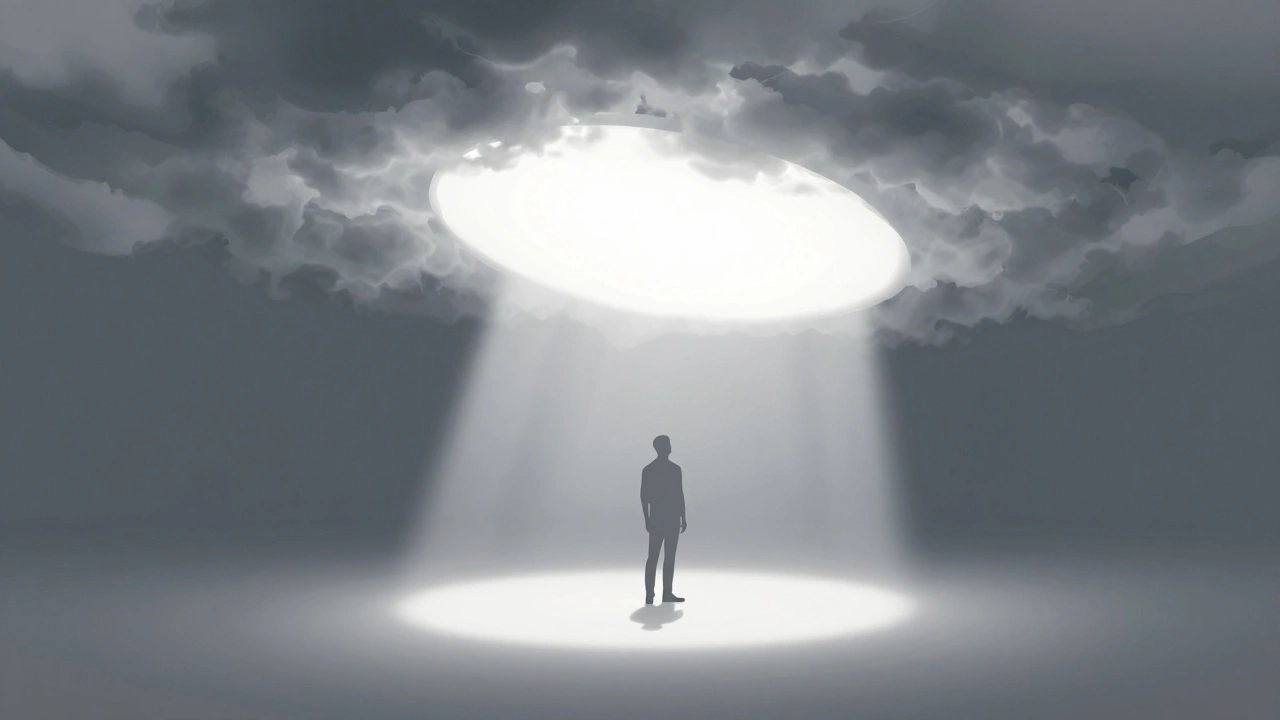
It is important to distinguish between "no light" and "diffuse light." Have you ever noticed that on a heavily overcast day, you don't cast a sharp shadow? The sun is still shining, but thick clouds scatter its rays in every direction. Light hits you from above, below, and all sides simultaneously.
Because the light is coming from everywhere, your body blocks very little of it relative to the surrounding area. The contrast between the "shadow" side and the "lit" side becomes so low that your brain stops registering a distinct shadow. The shadow technically exists as a slight reduction in photon count, but visually, it vanishes. This is similar to being inside a large, evenly lit white tent-the light bounces around so much that shadows become incredibly soft and faint.
How Night Vision Cameras See What You Cannot
This brings us to the technology that solves the problem of darkness: Night Vision Cameras. These devices do not rely on the same visible light spectrum that human eyes use. Instead, they use different methods to generate an image in low-light or no-light conditions.
There are two main types of night vision technology used in home security and surveillance:
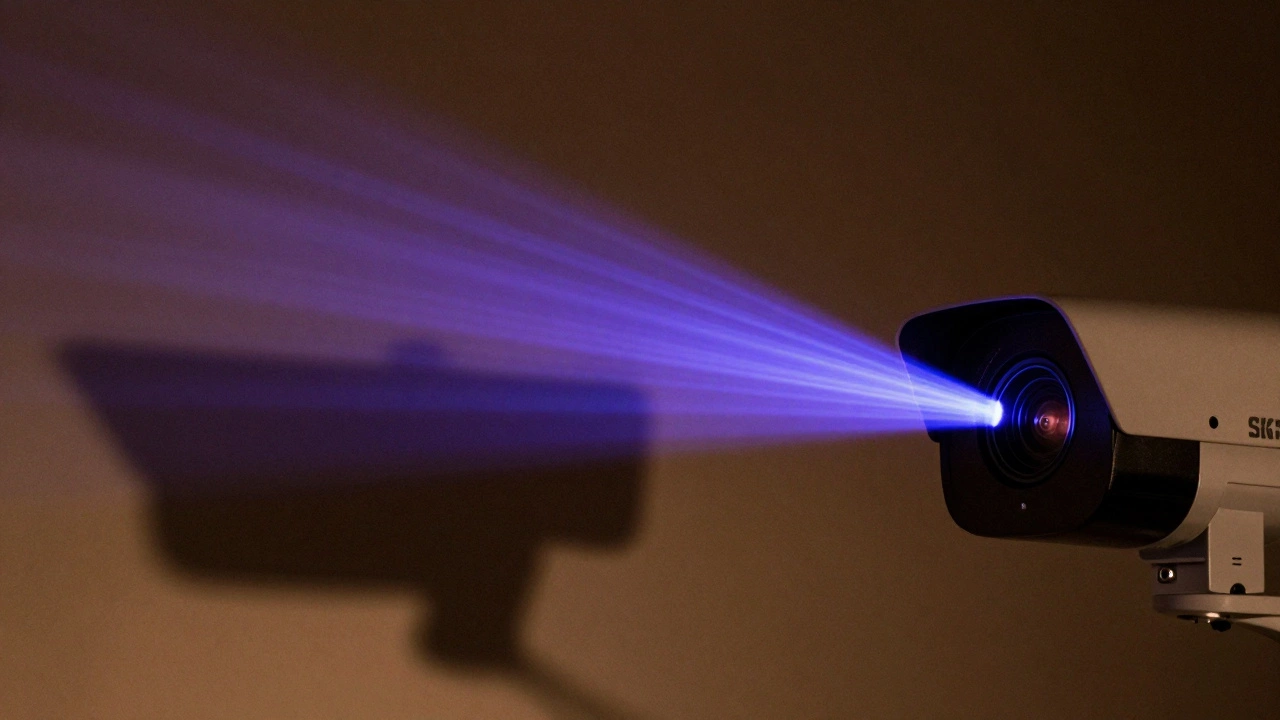
- Active Infrared (IR): Most standard security cameras fall into this category. They have small LEDs around the lens that emit infrared light. This light is invisible to the human eye, but the camera's sensor can detect it. When the camera senses that the environment is dark, it turns on these IR lights. The IR light hits objects and reflects back to the camera. Since the light is directional, it creates high-contrast images. Interestingly, because the IR light acts like a flashlight, objects close to the camera will cast shadows onto objects behind them, even though you cannot see the light source yourself.
- Image Enhancement (Low-Light): High-end cameras use sensors that are extremely sensitive to tiny amounts of visible light. They amplify whatever stray photons are present-moonlight, starlight, or distant streetlights-to create a color or monochrome image. These cameras often struggle more with shadows because there is less light to begin with, resulting in grainier footage.
So, while you cannot see your shadow in the dark, a night vision camera effectively creates its own lighting situation. By projecting infrared light, it ensures there is always a light source to block, meaning the camera can record shadows, depth, and detail even in a room that appears pitch black to you.
Comparison: Human Eye vs. Night Vision Camera
| Feature | Human Eye | Night Vision Camera (IR) |
|---|---|---|
| Light Requirement | Needs visible photons | Uses emitted infrared light |
| Total Darkness | Cannot see anything | Can see clearly (if IR active) |
| Shadow Visibility | No shadows without light | Creates artificial shadows via IR |
| Color Perception | Full color in daylight | Usually black and white |
| Adaptation Time | Takes 20-30 minutes to adjust | Instant switch-on |
Practical Implications for Home Security
Understanding how light and shadows work is crucial when setting up home security. Many people assume that placing a camera in a dark corner means it won't record anything useful. Thanks to infrared technology, this is rarely the case today.
However, there are pitfalls. If you point a camera directly at a strong light source, like a porch light, the sensor can get "blinded," washing out the image and making it impossible to see intruders or details. Conversely, if you rely solely on passive low-light sensors without IR illumination, you might miss critical details in areas with absolutely no ambient light, such as a basement or an unlit backyard path.
For the best coverage, choose cameras with adjustable IR intensity. This allows the device to balance the light output so that shadows are defined enough to provide depth perception, but not so harsh that they hide features in deep blacks.
Can I see my shadow in a room with only one candle?
Yes, you likely can. A candle provides a small, directional light source. Your body will block some of that light, creating a shadow on the walls or floor. Because the light is dim, the shadow may be soft-edged and faint, but it will be visible to the human eye if your eyes have adapted to the low light.
Do night vision cameras show colors?
Most traditional night vision cameras using infrared (IR) produce black-and-white images. However, newer "color night vision" cameras use advanced sensors and larger lenses to capture more ambient light, allowing them to display color footage in very low light conditions, though the quality may be grainier than daytime video.
Why do shadows disappear on cloudy days?
Clouds act as a diffuser, scattering sunlight in all directions. Instead of light coming from a single point (the sun), it comes from the entire sky dome. This reduces the contrast between the area behind you and the area around you, making shadows extremely soft and often imperceptible.
Is infrared light harmful to humans or pets?
No, the infrared light used in security cameras is non-ionizing and generally considered safe. It does not carry enough energy to damage tissue. However, some animals, like cats and dogs, may be able to see the IR glow as a faint purple or blue light, which could potentially distract them.
Can I see my shadow under water?
Yes, if there is a light source underwater. Water absorbs and scatters light, so shadows underwater tend to be softer and fade quickly with distance. If you shine a flashlight underwater, you will cast a clear shadow on the pool floor or rocks.